Thursday, December 21, 2017

Al Franken, the Loss of Truth, and the Problem of Credibility

Sen. Al Franken
Earlier today, Senator Al Franken delivered what seems to be his last floor speech in the United States Senate. Viewd out of context, it was a very good speech. In context, however, Franken's lost credibility mattered more than his final words. Franken had announced that he would leave the Senate after a string of credible allegations that he had engaged in sexual misconduct. A former comedian, Franken served Minnesota as a liberal Democrat. Most of his speech reviewed familiar Democratic positions: he attacked the recent Republican tax plan as a giveaway to the rich, discussed the dangers of climate change, and decried the loss of rights of transgender persons.

Concluding, Franken pointed out how important truth is:

I could go on and on and on and on. You know, before I came to the Senate, I was known as something of an obsessive on the subject of honesty in public discourse. But, as I leave the Senate, I have to admit that it feels like we are losing the war for truth. Maybe it’s already lost.

I could not agree more. Truth is in trouble, and people believe the silliest things. Some of the silly beliefs lead to great harm. In general, many media outlets, sadly including many prominent conservative outlets, have provided a platform for bizarre conspiracy theories and outlandish accusations. The unreliable website Gateway Pundit has become one of the main information sources on which conservative voters rely. Still, truth and politics have never gotten along very well. It would seem that Republicans have, for example, lied about their tax plan more often than the Democrats have lied about it, but, let's face it, lies are lies. Unless Democrats stop lying--completely--what is their credibility for complaining about Republican lies? The right amount of lying is zero, and once a liar has been caught, that person is, well, a liar.

So, let's remember that Franken gave this speech on his way out, and he is on his way out because of things he did out of the public eye. Let us suppose that he is right that truth is losing the war for public opinion. Who is going to believe Al Franken?


Aristotle wrote thousands of years ago that the speaker's character is the most powerful mode of persuasion. Once a speaker has lost the character battle, what is left?

Of course, many other members of Congress display various ethical problems: sexual behavior, corruption, incompetence, general venality. Yet, the public continues to elect people whose moral character is suspect, and, once they elect them, they don't trust them.  Or, worse, they trust the wrong ones.

Official Senate portrait

Wednesday, December 20, 2017

Nancy Pelosi's Tax Speech: Pitching Values to the Galleries

Nancy Pelosi
Speaking on the floor of Congress against the Republican tax reform bill, Democratic Minority Leader Nancy Pelosi called the bill, which awaits passage sometime today, as a "GOP tax scam" and a "brazen con job." The bill does, indeed, offer massive tax breaks to the very rich and to large corporations, including foreign corporations, while driving up the budget deficit. There is controversy about whether the bill will raise or lower taxes on lower and middle-class Americans. There is also controversy about whether the bill would stimulate massive growth. Fox News correctly noted that reactions to the bill have been very polarized. I'm not an economist and give no opinion about that one way or another about those latter issues, although I found a good article in the business magazine Forbes.

In her speech, Ms. Pelosi raised larger value questions: instead of focusing exclusively on nuts-and-bolts details, Pelosi said things like this:

Mr. Speaker, today, we choose what kind of country America will be. One that champions the ladders of opportunity for all, or one that reinforces the power of the wealthiest and well-connected. 

and, nearing her conclusion:


It does violence to the vision of our founders, it disrespects the sacrifice of our men and women in uniform who are  large part of our middle-class and to whom we owe a future worthy of their sacrifice, and it betrays the future and betrays the aspirations of our children. 

Ms. Pelosi quoted the United States Conference of Catholic Bishops, who, complaining about the harms to the working poor, called the bill "simply unconscionable." This appealed to a moral sense while citing the bishops' authority.


At the end, Pelosi reaffirmed values:

It demands--it morally demands--a "no" vote from every Member of this House of the people.

Ms. Pelosi surely knew that her voice would influence no votes. Her arguments would convince no Republicans to change his or her vote. Instead, she was reaching out to the larger audience, firing a salvo in what will likely be a long public dispute.


What lessons can we draw about public speaking? First, Pelosi spoke to the larger audience, not just the group in the room. (As President Donald Trump himself had done in an earlier tax reform speech.) Her very strong language--"tax scam" and "brazen con job"--was aimed at the general public, not the Congress. Second, she focused on values, using facts and figures only to aim at value questions. This drew attention away from esoteric issues that few of us really understand, and toward larger questions about the role of Congress in setting policy.


Official US Congress photo

Here's my follow-up post

Saturday, December 16, 2017

Donald Trump at the FBI Graduation Ceremony: Who Was the Audience?

Donald Trump at FBI Ceremony

Who is the speaker's audience? That sounds like a simple, obvious question with a simple, obvious answer. Sometimes it's not. President Donald Trump spoke yesterday at the FBI National Academic Graduation Ceremony. Shortly before his speech, Mr. Trump reamed out the FBI: "It's a shame what's happened with the FBI, but we're going to rebuild the FBI."  He may have been reacting to reports that some FBI agents involved in the Russia investigation opposed his politics. The FBI has long been considered to be among America's most conservative institutions, yet, during the Russia investigation controversy, some pundits claim that it has been taken over by liberals. This seems unlikely, but, well, people are entitled to their opinions. Mr. Trump said, "people are very, very angry" about perceived liberal bias in the FBI. Why, however, did the audience in an FBI facility not seem to be offended by Mr. Trump's anti-FBI stance? Why did Mr. Trump express opposite opinions on the same day?

Indeed, when he spoke a little later at the FBI ceremony, Trump effused praise: "For over 80 years, this rigorous and world-renowned program has trained America’s most dedicated local law enforcement officers from all across the country.  So respected." He continued: "You left home for 11 weeks to enroll in this program because you love your jobs, you love your communities, and you love your country." Quite different from "people are very, very angry!"

Actually, much of Mr. Trump's speech reviewed standard conservative positions such as that police departments were underfunded and "totally underappreciated." He lamented violent assaults against peace officers. He complained about urban violence, the MS-13 gang, and unfettered immigration.

What news reports often missed were two points:

1. Mr. Trump's real audience was his conservative voting base, not the group in the room. When a politician speaks, we should always assume that the speech represents political outreach. Mr. Trump knew that the speech would be widely reported, and, with his keen media sense, may even have known that the controversy would make it more widely reported.

2. Many in the room were not FBI people at all, but law enforcement personnel from across the country. It is possible that many FBI personnel would be offended by Mr. Trump's earlier anti-FBI remarks, but there were reports that most of the audience members were not FBI at all.  While he was addressing law enforcement in general during much of the speech, and by supporting law enforcement's hot-button issues, Mr. Trump knew that he ran less risk than one might think of a hostile audience reaction. Very clever? Or fortuitous?

Chaïm Perlman and Lucie Olbrechts-Tyteca put forward the idea that the real audience exists in the speaker's mind. Mr. Trump's FBI speech worked from that exact principle.

Thursday, December 14, 2017

Ordinary People in President Donald Trump's Tax Reform Speech

Donald Trump speaking on tax reform
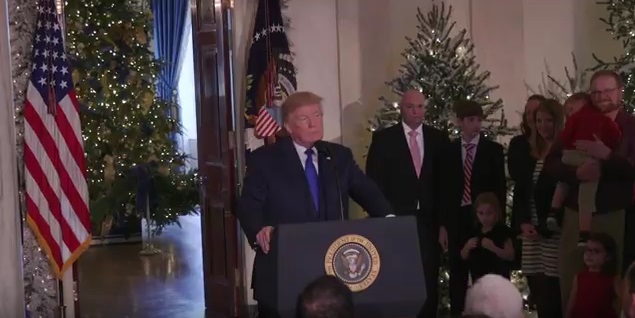
How does a president sell an unpopular tax plan? Surrounded by Christmas trees, President Donald Trump discussed tax reform from the White House yesterday. The Republican Party's proposed tax reform plan has led to much controversy, as some authorities think that it gives disproportionate tax cuts to very rich people, while others worry that some ordinary Americans will actually pay more in taxes. The possibility that much of the tax savings will go to overseas corporations has received less attention, but there seems to be good reason to think that is likely. Others express the unpopular view that no tax cut is needed at this time. Numerous pundits have complained that the tax plan was hastily written and poorly studied.

Of course, no one likes to pay taxes, and Mr. Trump's campaign and his inaugural address pictured him as a populist who would stand up for the ordinary, forgotten American. So, how to sell the tax plan? Mr. Trump returned to his populist roots to pitch the proposed tax plan as a bonus for the American people.

First, Mr. Trump emphasized those parts of the proposal that target ordinary Americans, while skimming past the tax cuts for large corporations. He promised to cut unspecified "special interest loopholes" and to lower "tax rates for families." He promised that "A lot of jobs are going to be created with the money that you spend--very special." 

He also promised that "We want to give you, the American people, a giant tax cut for Christmas. And when I say giant, I mean giant." He said that "The typical family of four earning $75,000 will see an income tax cut of more than $2,000, slashing their tax bill in half. It's going to be a lot of money." He promised to "expand the child tax credit for working families" (which has actually led to much controversy among Republicans in Congress).


Typical, ordinary Americans turned out, as far as this event was concerned, to consist of people from pro-Trump regions. So, Mr. Trump introduced Bryant and Ashley Glick from rural Pennsylvania, promising to reduce their tax bracket. Mr. Glick then commented that he would use the tax break for "home renovations." Next, the Kovacs family from Ohio, who Mr. Trump said would get "nearly one-third of their money back," talked about home renovations and saving for their children's college. The Giampolo family from Polk County, Iowa, Leon and Maria Benjamin from Richmond, Virginia, and the Howard family from Tenino, Washington expressed similar sentiments. Ending his speech, Mr. Trump asserted that Democrats actually liked the plan but opposed it for purely political reasons, and summarized that "With your help, we will bring back our jobs; we will bring back our wealth as a country; and, for every citizen across this beautiful land, we will bring back our great American Dreams."

There was no better way to identify with ordinary Americans than to bring them to the White House and give them a chance to speak. Linguist George Lakoff explains that people make political decisions on emotions, not logic. Mr. Trump did present a few facts and figures, but he ignored criticisms of the proposal and drew attention to ordinary, mostly rural Americans. This was powerful, populist, and emotional. Was it enough to make his case? Time will tell.

Wednesday, November 8, 2017

Donald Trump's Speech at the State Dinner in South Korea: A Unifying Speech

President Trump at State Dinner in South Korea
Although President Donald Trump is better known for divisive speeches, he gave a unifying speech at a November 7, 2017 state dinner with President Moon of South Korea, during President Trump's trip to Asia. My former professor Charles Urban Larson distinguished between the pragmatic speaking style, which we often associate with President Trump, and the unifying style, which brings people closer together.

The event started with a graphic in Korean and English: "We Go Together." President Moon's remarks emphasized the long alliance that the two nations shared. A toast was raised.

President Trump promised that the next day would be "exciting . . . for many reasons that people will find out." Well, surprise and suspense are classic Trump tactics. Mostly, however, Mr. Trump emphasized unity: "The partnership between our two nations and our two people is deep and enduring. We have been proud to stand by your side for many decades as an unwavering friend and a loyal ally." In what sounded like a response to North Korea's recent missile tests, he continued: "And you have never had a time where this ally has been more loyal or stood by your side more than right now." He also talked about "our close and abiding bonds of friendship."

Most ceremonial or epideictic speeches turn to values; this was no exception: "Together, our nations remind the world of the boundless potential of societies that choose freedom over tyranny, and who set the[m] free." That passage not only reaffirmed unity, but also reinforced democratic values. He praised South Korea for "South Korea's success and affirm our close and abiding bonds of friendship."

A notable feature was Mr. Trump's clear endorsement of the South Korea-United States alliance, which contrasted with Mr. Trump's earlier reluctance to fully endorse the North Atlantic alliance earlier this year.

Throughout the event, translators communicated the speakers' words. All in all, this was a safe speech: unifying, reassuring, dignified, carefully scripted. President Trump followed the script, caused no problems, and aroused no controversy. Sometimes, when danger lurks, calm reassurance is a speaker's best attitude.

Tuesday, November 7, 2017

Speakers Need Research: The Continuing Case of Donald Trump?

Donald Trump speaks to business leaders in Japan
Speakers need to do their homework before they say something, but I added a question mark to this blog post's title because the context of President Donald Trump's latest mistake remains unclear. Did he make a mistake at all, or did he just phrase his point a bit carelessly?

In a rambling, partly extemporaneous speech to American and Japanese businesspeople yesterday, Mr. Trump praised United States economic growth, complained about the United States trade deficit with Japan, and then said this:
 
"And we love it when you build cars -- if you're a Japanese firm, we love it -- try building your cars in the United States instead of shipping them over. Is that possible to ask? That's not rude. Is that rude? I don't think so. (Laughter.) If you could build them. But I must say, Toyota and Mazda -- where are you? Are you here, anybody? Toyota? Mazda? I thought so. Oh, I thought that was you. That's big stuff. Congratulations. Come on, let me shake your hand. (Applause.) They're going to invest $1.6 billion in building a new manufacturing plant, which will create as many as 4,000 new jobs in the United States. Thank you very much. Appreciate it. (Applause.)"
(I added the italics.)

The mainstream press jumped on Trump's statement because he implied that Japanese companies are not building cars in the United States. But is that what he meant?

Mr. Trump did, a moment later, talk about a Toyota-Mazda project in the United States. Second, he may have simply extemporized over his intended comment. He also promised quick approval for Japanese plants being built in the United States. Maybe he meant to say this: "And we love it when you build cars [in the U.S.A] . . ." but rushed to make his next point before he finished his previous point. Most of us make mistakes like that when we speak off-the-cuff. Still, from his phrasing, he didn't seem to know that about 3/4 of Japanese cars made in North America have final assembly in North American factories. If he had held that fact had firmly in his mind, he probably would have phrased his point more clearly. Research will often prevent a speaker from making mistakes like that.

Also, just before his controversial statement, Mr. Trump said this:

"I also want to recognize the business leaders in the room whose confidence in the United States -- they've been creating jobs -- you have such confidence in the United States, and you've been creating jobs for our country for a long, long time. Several Japanese automobile industry firms have been really doing a job."

That wasn't wrong, but maybe it was a bit unclear. Was he praising Japanese companies for creating jobs in the United States? Or not? Maybe . . .


Lost in the brouhaha is that Mr. Trump also complained that few American cars are exported to Japan, which is absolutely true, and which contributes to the trade imbalance. If he not have made his slip of the tongue, the press might have focused on that more important policy comment.

To his credit, a Washington Post columnist pointed out that Mr. Trump did acknowledge a new Japanese factory being built in the United States, and accused other reporters of "cherry-picking" Trump's comments.

More broadly, when I took college communication classes, my professors pointed out that important people like presidents often read their speeches precisely because the entire world will jump on them if they make a mistake. Judging from the video, Mr. Trump read part of the speech from a text, while extemporizing part of it. His delivery and presentation were much better when he was not reading, but his language was clearer when he was reading. For you and me, off-the-cuff speeches are sometimes the best. For a president, not necessarily so.

I've often blogged to show that speakers need research; for example, here.

Wednesday, November 1, 2017

Rose McGowan's Me-Too Speech: A Study in Language

I'd like to take a break from politicians and talk about Rose McGowan's "Me-Too" speech, which discussed sexual abuse, at the Women's Convention in Detroit, Michigan. McGowan's character resisted evil on the television show Charmed, and it was interesting to hear her talk about real-life evil. I'll talk little about her actual allegations and motivations--other people are more qualified to discuss them--and instead look at her language use, which featured sophisticated rhetorical tropes and figures of speech. Powerful language helps a speaker emphasize key points. The audience remembers points that a speaker expresses in powerful language.

First, the #MeToo hashtag is itself a neologism, that is, an invented term attributed to Tarana Burke. Unfamiliar phrases, especially if they are short and pithy, grab our attention. Referring to her own history as a sexual assault victim, McGowan used the "me-too" phrase to identify herself with her audience: "Thank you, Tarana Burke, thank you to all of you fabulous, strong, powerful me-toos, because we are all me-toos -- and thank you to Tarana for giving us two words and a hashtag that helped free us." McGowan continued by linking "I" and "we" statements to establish identity: "I have been silenced for twenty years," soon followed by "We are free. We are strong. We are one massive collective voice."

In that opening section, one also notes McGowan's parallel language: "We are free. We are strong. We are one massive collective voice." The "we are's" have a cumulative effect. She continued: "Its time to be whole. It's time [to] rise. It's time to be brave." Also parallel, also a cumulative effect.

A "monster" metaphor then drove home her attack on evil: "In the face of unspeakable actions from one monster, we look away to another: the head monster of all right now and they are the same and they must die." Repetition then drove her point home: "It is time. The paradigm must be subverted. It is time."

People respond well to groups of three, leading us to notice McGowan's rhetorical tricolon: "Name it, shame it, call it out." She ended with a brilliant allusion to Nathaniel Hawthorne: "The scarlet letter is theirs, it is not ours. We are pure, we are strong, we are brave and we will fight."

At the end of her speech, she tied her sense of unity and female empowerment into a thinly-veiled attack against Donald Trump's Access Hollywood scandal.

Effective, powerful language made this speech memorable.

Alas, McGowan was later charged with a drug offense. Too bad.