Tuesday, February 1, 2022

Stephen Breyer's Retirement Speech Reminded Us That the United States Is an Experiment. Will Our Experiment Succeed or Fail?

Stephen Breyer
Has the United States become a failing experiment? When Supreme Court Justice Stephen Breyer announced his retirement on January 27, 2022, public attention focused on the search for his replacement. As so often happens, people missed his point. Breyer taught an important lesson. Let’s not overlook it. He warned the United States about its political peril, while pointing to all of us to find a solution. He told us to be optimistic, but he also said that the nation’s success was up to all of us.

In his speech announcing his retirement, Supreme Court Justice Stephen Breyer called the United States of America “an experiment.” What an interesting word. Experiment. After almost two and a half centuries, we are an experiment? If we listen between the lines, however, we hear that Breyer’s speech offered a warning tempered by optimism. We only deserve to be optimistic if we heed his warning. That’s the irony. Was he right? After all these years, is United States still an experiment? Will our experiment succeed or fail? That is up to us, the experiment’s citizens. That was his message.


What Did Breyer Mean? An Experiment?

First, the United States was the first major nation in many centuries to establish itself as a constitutional republic. It was indeed, at its founding, an experiment. The nation’s Founders did not think about the United States Constitution as a sacred document. They considered it an experiment. That was, as we will see, Breyer’s first point.

Second, however, experiments can fail. That is the scary part. Breyer alluded, however indirectly, to the United States’ ongoing political crisis.


Is the United States Constitution an Experiment?

Breyer faced a rhetorical challenge As a judge, he wanted to rise above the political fray. Yet, he gently reminded the nation of its political crisis. To show that the United States is indeed an experiment, Breyer quoted Abraham Lincoln’s Gettysburg address. During the Civil War, Lincoln saw that the United States itself, the very idea of constitutional government, was on trial:
“And we are now engaged in a great civil war to determine whether that nation or any nation so conceived and so dedicated, can long endure.”
Breyer continued:
“See, those are the words I want to see: an experiment. And that’s what he thought. It’s an experiment.”
Breyer then reached farther back into history to cite the nation’s first president, George Washington:
“And I found some letters that George Washington wrote where he said the same thing: It’s an experiment. That experiment existed then because even the liberals in Europe, you know, they’re looking over here, and they’re saying that great idea in principle, but it’ll never work. But we’ll show them it does. That’s what Washington thought. And that’s what Lincoln thought. And that’s what people still think today.”
By mentioning today, Breyer asked his listeners to think about the American experiment in the present time.


Breyer Said That It’s All up to Us, the Americans of Today

It is indeed at the present time, generations after the nation’s founding, that people need to protect the American experiment. All of us, he said. Breyer continued:
“It’s us, but it’s you. It’s that next generation and the one after that. My grandchildren and their children. They’ll determine whether the experiment still works. And of course, I am an optimist, and I’m pretty sure it will.”

 
Yet, Not Everyone Believes in Our Republic

In polls, most Republicans still falsely claim that the 2020 election was stolen and that Trump actually won. Legislatures across the country are passing laws that put up absurd obstacles to restrict voting. In Texas, where I live, a mail-in ballot application has to list the Social Security number, driver’s license number, or voter number that the person used to register. Yet, in the news we learned that a World War II veteran registered many years ago, when none of those numbers were required. He therefore cannot obtain a mail-in ballot. The 95-year-old man promises that he will drag himself to the polls in person if necessary.
______________

______________

You don’t have to be 95 years old to have a problem. What if you don’t remember which number you used? Texas counties are rejecting as many as half of the ballot applications. What legitimate purpose can those mysterious voting rules serve? None, obviously. Their only purpose is to keep people from voting. Unfortunately, similar stories can be told across the nation.

In January 2021, for the first time in our nation’s history, we did not have a peaceful transfer of power. Seeking to overthrow the 2020 election, a raging mob, egged on by Republican leaders, ransacked the United States Capitol to overthrow the election’s results. After fleeing – fleeing from their own supporters! – many Republicans in the Congress bowed to the rioters and voted not to certify the election results. The United States’ constitutional system, which once seemed so secure, nearly collapsed. Is our experiment failing?

Yes, in much of the United States, the Constitution is still an experiment. The people who try to suppress American voters do not believe in the American experiment. They think that we will be better off if the experiment fails. Driven by fear – the fear of change – they seek to replace our republic with government by an arrogant minority.


What Can American Citizens Do about It?

Knowing all of this, Breyer still felt optimistic. For our American constitutional experiment to succeed, however, people have to care enough to fight for it. I don’t mean that they should fight with guns or knives. I mean to fight by voting and raising one’s political voice. That’s what Justice Breyer intended. When Abraham Lincoln himself ran for president in 1864, voter turnout ran over 73%. That was in the middle of the Civil War. Voter turnout in 2020 was less than 67%. And politicians boasted about the high turnout! Few of my university students could name the three branches of the federal government or remember who represented them in Congress. Too many gullible people believe whatever they hear on the television. Will our experiment succeed? Or fail? Let’s hope that Justice Breyer was right. Let’s hope it succeeds.

If our experiment is to succeed, people need to look for ways, big and small, to contribute to communities, and, indeed, the entire nation. Being an American means more than just to get a good job and make a lot of money. And, please, no matter what your political views might be, overcome any obstacles, register to vote, and participate in every election. A citizen’s most basic duty is to vote. Everything else is secondary.

We often blame our leaders when we have problems. Nevertheless, in a healthy republic, the people are the final authority. Let’s all take responsibility to heal our nation. As William Jennings Bryan once said, “We have submitted the issue to the American people and their will is law.” 

Was Justice Breyer’s speech too mild-mannered for our angry times? Maybe. Yet, is it not long overdue for us to tone down our political anger? Breyer was hopeful that the American people’s basic goodness will triumph. Let us all hope that he was right.

Justice Breyer was right. Our nation is an ongoing experiment. The experiment’s success is up to us. It rests on our shoulders. It rests on the shoulders of every generation.

______________

______________

Saturday, January 22, 2022

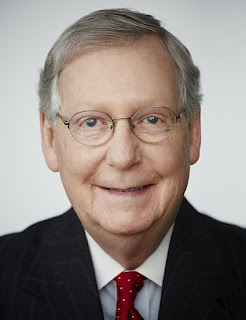
Mitch McConnell and the Art of Dog Whistles

Mitch McConnell
Mitch McConnell and the racist dog whistle ride again. In political rhetoric, a dog whistle is a statement that can say something different to different audiences. That is like the way that a dog might hear a whistle that a person cannot. Asked during a recent press conference about the concerns that people of color felt about voting rights in the United States of America, Senate Minority Leader Mitch McConnell said this:
“Well, the concern is misplaced, because if you look at the statistics, African American voters are voting in just [as a] high percentage as Americans. A recent survey 94% of Americans thought it was easy to vote. This is not a problem.”
Of course, “this is not a problem” is the conservative mantra. If you pretend that nothing is wrong, you can pretend that you don’t need to change. By falsely denying that voter suppression is real, McConnell could pretend to justify his anti-voting rights agenda.


Dog-Whistle Speech

Politicians speak in dog whistles so they can deny what they themselves say. In this case, McConnell could deny that there was a problem in the same breath that he helped to cause the problem. Similarly, one might recall that former President Ronald Reagan talked about “young bucks and “welfare queens.” Everyone knew that he was talking about African Americans. Still, since these were dog whistles and not explicit statements, Reagan could blithely deny any racist intent. His racist core voters got the idea. Yet, the proverbial suburban housewives could pretend they heard no racist content. Likewise, when King Henry II supposedly asked, “Will no one rid me of this turbulent priest?” it didn’t sound like a solicitation to murder. It was a deniable dog whistle.

McConnell’s dog whistle itemized a racial divide. His critics jumped on the obvious. McConnell distinguished between “Americans” and “African Americans.” Otherwise, he could have said that African Americans vote at the same rate as other Americans. That would have been untrue, as we will see in a moment, but it would acknowledge that Black people are Americans. Instead, McConnell’s words implied that African Americans aren’t Americans. A person might, in contrast, say that Polish-American voters vote at a higher (or lower) percentage than Ukrainian-American voters. That might make at least a little bit of sense. McConnell did something else. He distinguished between African-Americans and (real?) Americans.

McConnell, of course, quickly denied that he meant to do any such thing. “I’ve never been accused of this sort of thing before,” he said, “and it’s hurtful and offensive.” He then described his commitment to civil rights in the 1960s, saying that he had attended the 1963 March on Washington and that he witnessed President Lyndon Johnson signing the Voting Rights Act of 1965. He also explained that he had, over the years, hired African Americans to work in his office. This led Charles Booker to comment, “Mitch McConnell wants you to know it’s fine for him to block Voting Rights because he has Black friends.” Of course, anyone who grew up in the South in the pre-Civil Rights era – as I did – knows that “I have many Black friends” is the racist’s favorite refrain.

None of McConnell’s defensive comments about a distant past, however, explain why he opposes voting rights legislation today. So, we ask, what did McConnell really mean? To understand dog-whistle communication, we need to listen for clues as to the speaker’s real meaning. We also need to listen for what the speaker did not say. After all, what a speaker does not say can convey as much meaning as what the speaker does say.

The Golden Trump at CPAC 2021: Why Is the Christian Right Silent?

Politicians often use dog whistles to sneak in their true meanings. For example, predating McConnell’s outrageous statement, former President Donald Trump once said that “MAGA loves black people. ” That implied that Black people were not part of Trump’s MAGA crowd. Pretty much the same thing that McConnell implied.

Donald Trump Says That the MAGA Crowd Loves Black People, Except When They Don’t


Why Speak in Dog Whistles? 

Dog-whistle communication gave McConnell a clever way to speak out of both sides of his mouth. Did McConnell respond to the uproar by supporting any kind of voting rights legislation, however moderate? No. Did he specifically assert that “Yes, African-Americans are real Americans?” Not that I have heard. He defended himself, but that is not the same as denying his dog-whistle meaning. His core supporters can come away confident that McConnell sides with their opposition to civil rights. More moderate Republican voters can pretend that he was misunderstood. The dog whistle helped McConnell appeal to a bigger audience than what he could reach if he spoke clearly.

Was McConnell’s statement undeniably racist? Well, no. He did not use the N-word. He did not accuse Black people of being lazy or ignorant. His statement was obvious but deniable, which is the whole point of a dog whistle. We all know that Mitch McConnell pretends to support voting rights when he does not. Unfortunately, because of his tricky way of speaking, it’s hard to prove. Yet, how can we solve our nation’s problems if we can’t even acknowledge them?

Scholars sometimes call dog-whistle speech “multivocal communication.” What that means is that a single statement can mean different things to different audiences. In this case, “African American voters are voting in just as high a high percentage as Americans” carries at least two meanings. It can mean that African-American voters and American voters are two different groups. It also could mean that McConnell found a statistical equivalence between the voting rates of White Americans and Black Americans. The first implication is much more racist then the second – not that either is defensible. 


Fact Check: Was McConnell Right? No.

By the way, did McConnell have his facts right? Of course not. The United States Census Bureau found that 71% of qualified white voters voted in the 2020 election. This is substantially more than the 63% voter turnout rate of African-Americans.

What about my own experience? I have lived in the voter suppression states of South Carolina and Texas since 2005. The most recent scandal results from Texas’ new voter suppression law, which restricts mail-in ballots. When you fill in the mail-in ballot application, you need to write down your driver’s license number, your voter ID number, or the last four digits of your Social Security number. However, what if you originally registered to vote, maybe years ago, using your voter ID number, and yet put your driver’s license number on the application?  Or vice versa? The application will likely be rejected. Rejected applications need to be refiled. There is no guarantee of success, since the state’s voter records are a mess. Or, when I lived in South Carolina, voting locations changed willy-nilly, often with no notice to voters. These are just two of the 19 states that have proposed or adopted aggressive voter suppression laws. Yes, contrary to Mitch McConnell, some states pull nasty tricks to suppress voter turnout.

And, since voter suppression is patently unjust, politicians like McConnell speak in dog whistles to conceal or distract. It did not work this time. Often enough, however, it does.   
_________________

Other examples of dog whistle speech:

Were Trump’s Tweets Racist? They Were (Sort of) Deniable Dog Whistles

“And This Is Their New Hoax:” Donald Trump’s Six Deadly Words Still Ravage Our Nation
_________________

Research note: Interested readers will want to look at Bethany Albertson’s important article to learn more about multivocal communication.

Image: Congressional photo, via Wikimedia  

Monday, January 17, 2022

Martin Luther King's Speech “Love, Law, and Civil Disobedience:” The Radical Tradition

Martin Luther King, Jr., whose national holiday we celebrate today, gave his most influential speech on November 16, 1961. This speech is called “Love, Law, and Civil Disobedience.” Like many speakers before and since, King showed that his seemingly radical ideas rested on strong traditions and historical precedents. He showed that people stand in an ancient tradition when they break unjust laws.


A Thoughtful Speech

The speech, which he presented to a group of student civil rights workers, did not rise to the heights of thrilling oratorical excellence for which King was remembered. So, why do I say that it was influential? That’s because “Love, Law, and Civil Disobedience” was a carefully reasoned speech that shaped, justified, and explained the principle of nonviolent resistance to racial oppression. This speech, now largely forgotten, guided the Civil Rights movement. That movement would reach its climax three years later, during the Birmingham demonstrations, with the Civil Rights Act of 1964 and the now-gutted Voting Rights Act of 1965 soon to follow.

In my previous post, I explained how this speech laid out the Civil Rights’ movement’s philosophical and moral foundation. The speech also justified the principle of nonviolent resistance to unjust laws. While King’s philosophical foundation relied heavily on Christian theology, his principle of nonviolent resistance owed more to Mohandas Gandhi and New England transcendentalism. Like many speakers before and since, King showed that his seemingly radical ideas rested on strong traditions and historical precedents.

Radicals, like King, seek social change. Conservatives look to tradition. Paradoxically, King combined the two opposing ideas. His agenda, which called for sweeping social and legal change, were considered radical in 1961. They would still be considered radical in 2022.

Yet, King’s astute persuasive tactic helped make his methods seem – well, not radical at all. By tying nonviolent resistance to history and tradition, King implied that his movement’s actions were traditional. More than that, however, he turned his critics’ arguments against them. It was they and not King, who rejected tradition – the tradition of civil disobedience. This was King’s subtext.


The History of Civil Disobedience

To begin with, King started with Greek philosophy. “There is nothing new about this,” King insisted. Indeed, he said that “We go back and read the Apology and the Crito, and you see Socrates practicing civil disobedience.” King also appealed to religious tradition, pointing out that early Christians also refused to obey unjust laws:
“The early Christians practiced civil disobedience in a superb manner, to a point where they were willing to be thrown to the lions. They were willing to face all kinds of suffering in order to stand up for what they knew was right even though they knew it was against the laws of the Roman Empire.”
How many conservative Christians have thought about that? About a time when the very act of worshipping as a Christian was civil disobedience? Not stopping there, King reminded the students that the United States of America has a long history of civil disobedience. He mentioned the Boston Tea Party and the work of pre-Civil War abolitionists:
“And even let us come up to America. Our nation in a sense came into being through a massive act of civil disobedience, for the Boston Tea Party was nothing but a massive act of civil disobedience. Those who stood up against the slave laws, the abolitionists, by and large practiced civil disobedience.”
The point here? Few of King’s opponents in 1961 would try to say that slavery was just. The abolitionists, who were the radicals of the 1850s, worked against the monstrous laws that perpetuated slavery. History now admires them. They became heroes – to later generations – by helping slaves to escape. However, they were heroes only because they broke the law. That obvious fact gave King a powerful historical and moral precedent.

There is, however, the other side. Are laws not supposed to be the guardians of public order and morality? Are we doing the right thing when we follow the law? Sometimes, King said, we are not.
 

What Is Legal Isn’t Always Right

In other words, that something is legal does not, in King’s philosophy, mean that it is right. Indeed, the law might require you to do something wrong. That was a radical concept – it is hard to imagine a more radical idea – and yet King’s logic seems inescapable. Throughout large parts of the United States in 1961, racial discrimination and oppression were actually required by law. Did that make it right? Was it right for people to obey such laws?

King offered a powerful rebuttal, founded on history and yet tied to the present day. King insisted that actions are not always righteous just because they are legal. He asked people to rise above popular morality and legal principles. He said that we should instead live by conscience. That is a difficult challenge, to which few of us ever rise.

For example, King reminded the students that Nazi Germany applied the force of law to commit acts of stunning evil. Evil people created Nazi law for evil purposes. King called for his workers to have the courage to reject legal but monstrous evil like Hitler’s:
“We must never forget that everything that Hitler did in Germany was ‘legal.’ It was illegal to aid and comfort a Jew, in the days of Hitler's Germany. But I believe that if I had the same attitude then as I have now I would publicly aid and comfort my Jewish brothers in Germany if Hitler were alive today calling this an illegal process.”
King also reminded the students that the Union of South Africa was, in 1961, a white supremacist nation. In South Africa, racial justice was actually a crime. King expressed support for the resistance that Black-majority leaders offered against South Africa’s cruel, but legal, regime:
“If I lived in South Africa today in the midst of the white supremacy law in South Africa, I would join Chief Luthuli and others in saying, break these unjust laws.”
For, yes indeed, apartheid (which was legally required racial oppression) was enshrined in South African law. Yet, it was obviously wicked and unjust.


What Is Legal? What Is Right?   

These examples led King to a powerful but daring conclusion. He insisted that the students in his audience, who were organizing nonviolent resistance, actually represented tradition. That claim utterly conflicted with conventional attitudes. Yet, King gave his opponents a chance to ask themselves some hard questions. Would they have supported Hitler? South African apartheid was legal. But was it right? King put his opponents in difficult position. Were they prepared to defend some of the century’s most horrible laws? Were they prepared to defend oppression in the United States?

Two years later, King would write his famous “Letter from a Birmingham Jail.” That letter, which I recommend in the highest terms, laid out, in much more detail, the same historical and philosophical principles that King had already explained in “Love, Law, and Civil Disobedience.” King’s speech made nonviolent resistance into a moral obligation. King tied civil disobedience to tradition, while rejecting unjust laws. And it was in this now-forgotten speech that King laid out the philosophy that guided the Civil Rights movement for years to come. 

________________
 

Related Public Speaking Posts: 

Read First Post about King's speech: 
Martin Luther King, Jr.'s Speech, “Love, Law, and Civil Disobedience:” The Civil Rights Movement’s Philosophical Foundation

Martin Luther King, Jr. at the Mountaintop in Memphis, Tennessee: A Speech for the Ages

French President Macron Reminds the USA of Its Traditions

Rabbi Michael Z. Cahana’s Sermon about the Summer of Love: Is Love the Answer to Nazism?

________________

Research Note: Radicals often look for ways to tie their ideas to tradition. In his award-winning book, The Prophetic Tradition and Radical Rhetoric in America, Professor James Darsey shows how radical speakers often quote the Hebrew prophets.

Was “Love, Law, and Civil Disobedience” totally neglected? No, not entirely. It was reprinted in several editions of an advanced communication textbook, Contemporary American Speeches, which was co-edited by my professor Richard L. Johannesen.

Sunday, January 16, 2022

Martin Luther King, Jr.'s Speech, "Love, Law, and Civil Disobedience:" The Civil Rights Movement’s Philosophical Foundation

What does it mean to be good? How do we resist evil? Where should we put our faith: in goodness, or in violence? Martin Luther King, Jr.’s carefully-reasoned speech, “Love, Law, and Civil Disobedience,” delivered to a group of civil rights workers, laid out the Civil Rights Movement’s profound values. King’s carefully-reasoned exposition gave the movement its philosophical underpinning. Drawing on his academic background in Christian theology, South Asian philosophy, and New England transcendentalism, King did not merely guide his workers. More importantly, he called the United States to its better nature.

King did not give his speech with the overall public in mind. He delivered this speech on November 16, 1961 in Atlanta, Georgia to a student group called the Fellowship of the Concerned. He did not instruct them about movement tactics. Instead, he delved into the morality on which the movement rested. That moral foundation is King’s eternal legacy.

Although most remembered for fiery heights of eloquence like his “Mountaintop” and “I Have a Dream” speeches, King also guided his movement with deep moral arguments. In “Love, Law, and Civil Disobedience,” King began with the idea that people are capable of great goodness. King also showed that it is never right to cooperate with evil, just as, in contrast, we should have boundless faith a future of justice. Let us look at each of those ideas in turn.


Are People Basically Good?

King’s first profound insight was that human beings are good. That insight was remarkable because the United States was, at the time, dominated by appalling racial wickedness. A few months earlier, a crowd of white people had fire-bombed a bus full of the Freedom Riders, viciously beating the men and women as they escaped.

Let us remember that, in 1961, racial discrimination was still the law of the land, particularly in the states of the former Confederacy. In my home state of Virginia, interracial marriage was still a serious crime. Not until I started my Master of Arts degree at Northern Illinois University did I attend an integrated school. (My high schools and undergraduate college enrolled only one or two token minority students.) The Supreme Court ruling in the case of Brown versus the Board of Education was merely a document on paper. It made little difference to education. John Birch Society stickers plastered my middle-class neighborhood.

Many people imagine that chain gangs are a relic of the distant past, but I often witnessed this horror as an adolescent in the 1960s. There were no body cams to bring justice to the victims of police brutality. Rural areas of the Deep South were still, for all practical purposes, police states. African-Americans who went to the voting booth feared for their lives, and people who were arrested and taken to southern jails were often never seen again. Lynching continued openly as late as 1981, when the Ku Klux Klan hanged Michael Donald in Mobile, Alabama. And, yet, King insisted that people are capable of great goodness. His ultimate point, his foundation, was to assume that the Civil Rights movement could appeal to kindness rather than hate. Love could replace anger. King explained it like this:
“I think this is what Jesus meant when he said, ‘love your enemies.’ I’m very happy that he didn’t say ‘like your enemies.’ because it is very difficult to like someone bombing your home; it is pretty difficult to like somebody threatening your children; it is difficult to like congressmen who spend all of their time trying to defeat civil rights. But Jesus says love them, and love is greater than like. Love is understanding, redemptive, creative, goodwill for all men. And it is this whole ethic of love which is the idea standing at the basis of the student movement.”
And he summed it up with this simple message of hope:
“There is within human nature an amazing potential for goodness.”
Are violence and hate the only ways to defeat our enemies? If so, King’s philosophy of civil disobedience comes to nothing. If we reach our opponents’ hearts, he suggested, people could hope for a better future.


Do Not Cooperate with Evil

Yet, King made another point, which was not to cooperate with evil. This principle applied to the movement’s followers, just as it applied to the racists and politicians who perpetuated evil. He did not say to “resist evil,” which we hear more often. Instead, he reached more deeply. He told his followers not to acquiesce to evil:
“It is as much a moral obligation to refuse to cooperate with evil as it is to cooperate with good. Noncooperation with evil is as much a moral obligation as the cooperation with good.”
My late mother, who loved to read history books, often commented that people like Hitler and Stalin could only come to power if a great number of people helped them. Even more so, of course, it is so easy to go along with injustices. Martin Luther King, Jr. warned the students to avoid that temptation.

It is from that principle, that we should not cooperate with evil, that led King to the idea that not to give in to unjust laws, such as Jim Crow laws and legalized racial discrimination. While conservatives value social order above all else, King asked the students to value morality above all else.


And Have Faith in the Future

Many people, in 1961 and 2022 alike, prefer to glory in a mythical past. Instead, King offered hope for a better future. The Christian concept of “faith” can equally be translated as “trust.” Thus, King asked the students to hope, expect, and, most of all, work for, a better future:
“This movement is a movement based on faith in the future. It is a movement based on a philosophy, the possibility of the future bringing into being something real and meaningful. It is a movement based on hope.”
The message of American conservativism is, obviously enough, that we don’t need to solve our problems if we pretend we don’t have any. Yet, never mentioning his opponents’ philosophy, King’s speech did not merely ask the students to recognize the horrors that racism had brought to the United States. He also asked them to hope and work toward a better day when justice could triumph:
“With this faith in the future, with this determined struggle, we will be able to emerge from bleak and desolate midnight of man’s inhumanity to man, into the bright and glittering daybreak of freedom and justice.”
In a later post, I’ll talk about this speech’s justification for civil disobedience. For now, however, let us remember that King’s speech showed faith in humanity’s goodness. He reminded his workers never to cooperate with evil. Still, while recognizing evil, he expressed profound faith – profound trust – that they could work toward a glorious future of just peace and human kindness. He presaged the vision that he would express two years later from the Lincoln Memorial, “With this faith, we will be able to transform the jangling discords of our nation into a beautiful symphony of brotherhood.” As the United States somewhat reluctantly celebrates Martin Luther King, Jr. during this three-day holiday weekend, is his work finished? I think not. Should we still remember to deny cooperation with evil? I think yes. Do we still need to remember King’s message of love, hope, and faith? Obviously, we do.

Part of King’s genius is that he rarely bothered to refute the fallacious arguments that conservative racists made against him. Instead, he offered a powerful vision. That vision overcame whatever venom or false promises his opponents might talk about. He did not condemn his opponents; instead, he offered them a chance to reform. He did not fact-check the liars; he overwhelmed them with moral power. With the resurgence of brazen Jim Crow laws across the South, we still need his lesson today.

Peace to all.

Thursday, December 16, 2021

Liz Cheney and the Firehose of Truth: Using the Republicans' Text Messages Against Them

“We are under siege in the Capitol.”

“We are all helpless.”
Those are just two of the text messages that Republican Congresswoman Liz Cheney quoted in her speech to Congress on December 13, 2021.  She read a series of text messages sent to former White House Chief of Staff Mark Meadows. The messages all date to the January 6, 2021 riot at the United States Capitol. The messages were presumably from Republican politicians. Cheney cited messages, one after the other, that asked Donald Trump to call off the attackers.

In other words, she unloaded a firehose of truth, proving her point by quoting message, after message, after message.
Liz Cheney, official portrait
 Cheney gave far more evidence than she needed. Much more than the minimum. Such massive evidence can be persuasive; the RAND corporation shows how pro-Trump Russian propaganda outlets use the “Firehose of Falsehood” to spread propaganda. Propaganda artists spew out more lies than anyone has time to refute. In contrast, Cheney used a firehose of truth. She gave the proof. That is why, helpless in the face of her facts, conservatives have not even tried to rebut her.
A firehose of truth
Unlike so many speakers, Cheney had done her homework. The effect was devastating.
 

Cheney States Her Point

Cheney’s thesis was that Former President Donald Trump had failed to do his duty to control the January 6 rioters. That crowd was shouting things like “stop the steal” and “hang Mike Pence.” Their announced goal was to use violence to stop the counting of the electoral votes that made Joe Biden President. Trump delayed for hours before asking the rioters to go home. Cheney’s secondary thesis proved that Fox News hosts knew that Trump was behind the riot, even though they would broadcast false accusations that the rioters were left-wingers.

To prove those points, Cheney read a string of text messages that Meadows had produced for the congressional committee investigating January 6. She read from a manuscript in a calm, nearly expressionless voice. She proved her points by turning people’s own words against them.

She began with her thesis:
“Mr. Meadows received numerous text messages that he produced without any privilege claim, imploring that Mr. Trump take the specific action that we all know his duty required. These text messages leave no doubt that the White House knew exactly what was happening here at the Capitol.”


Cheney Proves Her Point 

She then read a string of text messages sent to Meadows:
“One text Mr. Meadows received, ‘You are under siege at the Capitol.’ Another, ‘they have reached the Capitol.’ And a third, ‘Mark, protesters are literally storming the Capitol. Breaking windows and doors, rushing in. Is Trump going to say something?” ‘There is an armed standoff at the House Chamber door,’ and another from someone inside the Capitol, ‘We are all helpless.’”
Again, without a break, barely pausing for breath, she continued her firehose:

“Dozens of texts, including from Trump administration officials, urged immediate action by the president: ‘POTUS has to come out firmly and tell the protesters to dissipate. Someone is going to get killed.’ In another, ‘Mark, he needs to stop this. Now.’ ‘Tell them to go home.’ POTUS needs to calm this s—t down.”

Notice that, by this point, Cheney was simply reading a string of text messages, all on the same theme, all directly supporting her point. Not only their clarity, but their sheer numbers, rendered her point irrefutable.

She then turned her massive evidence against the duplicitous Fox News hosts who, only a few hours later, would be telling people that the January 6 rioters were actually left-wingers who supported Biden:
“Multiple Fox News hosts knew the president needed to act immediately. They texted Mr. Meadows and he turned over those texts. ‘Mark, the president needs to tell the people in the Capitol to go home. ...This is hurting all of us…He is destroying his legacy,’ Laura Ingraham wrote. ‘Please get him on TV. Destroying everything you have accomplished.’ Brian Kilmeade wrote. Can you make a statement? … Ask people to leave the Capitol.’ Sean Hannity urged.”
Cheney’s long string of quotations eliminated all doubt. We all understand beyond question that Republican leaders and Fox News hosts knew that the rioters were Trump’s people and were under his control. The sheer power of Cheney’s speech is reflected by the fact that, for the most part, conservative media are making little effort to refute her. For the most part, they are ignoring her speech. They are ignoring a speech that no one could ignore. It was not until the next day that Fox News made even a feeble effort to discuss the text messages. Trump himself remains silent. As of this writing, I can find nothing about Cheney’s speech on the websites of the conservative National Review, Breitbart, or other right-wing outlets.

So, for the moment at least, Liz Cheney and her allies on the January 6 committee now control the public agenda. Even more, when Cheney mentioned “dozens of texts, including from Trump administration officials,” she tantalized the audience by hinting that the January 6 Committee has tanks full of more evidence. Trump’s supporters are no longer setting the agenda.


And She Gave a Public Speaking Lesson  

Thousands of years ago, the Greek philosopher Aristotle explained that the two essential parts of the speech are to state your case and prove it. That is exactly what Liz Cheney did. She stated her point in simple, bold language. She then presented massive evidence to support her point.

So, we learned a lot about the January 6 Capitol riots from Cheney’s brief speech. She also taught us two public speaking lessons:

1. State your case and prove it. Good advice from the old days.

2. Do your homework and show your audience the facts.

Liz Cheney showed how it is done. She made it seem simple. Do your homework and prove your point. Now, although the conservative media are thrashing around to change the subject, it looks as if the irresistible truth is coming out.


Earlier Post: Liz Cheney Reminded Us of Our Values
_____________

P.S.: Cheney’s expressionless delivery was, oddly enough, perfect for the occasion. Instead of sounding like an angry radical, she projected a serious demeanor. Reading from a manuscript ensured that she got the quotations exactly right.

P.P.S: There are minor differences between Cheney’s text and the speech as she delivered it. As usual, her prepared text was polished. She ad-libbed during the presentation to make a few points extra clear. For the most part, this post uses the speech as delivered. C-SPAN provided a video and rush transcript. NPR published a polished text. To understand everything she said and meant, we should pay attention to both versions. None of the differences affect her message. 

Saturday, November 27, 2021

Is The Coronavirus an Invisible Enemy? Donald Trump’s Second-Most Influential Speech

Coronavirus, CDC image
Former president Donald Trump delivered his second-most influential speech during a Coronavirus Task Force Update on March 16, 2020. The coronavirus pandemic was the gravest crisis that Donald Trump faced (or failed to face) during his presidency. It inevitably gave rise to his two most influential speeches. I wrote about his “their new hoax” speech a couple of months ago. Now, let us look at the second one, where he called the virus “an invisible enemy.” He helped people pretend that they could ignore the virus. People do not avoid public health measures because they value freedom more than life. No, they ignore the coronavirus because Trump helped them pretend it wasn’t a big deal. No, the virus was invisible, just as unsafe water and gamma radiation are invisible. Out of sight, out of mind. 

Earlier Post: “And This Is Their New Hoax:” Donald Trump’s Six Deadly Words Still Ravage Our Nation

Trump’s most important speeches helped his supporters escape from reality. Trump helped people think that he did a great job with the pandemic - by downplaying it. Let us recall that many presidents have given influential speeches about momentous national and international issues. Trump himself gave such speeches. In contrast, however, Trump’s rhetorical response to the virus boiled down to two influential phrases: “This is their new hoax,” in February 2020, and “An invisible enemy,” in March 2020. Why should we wear an itchy mask or take a vaccine to protect ourselves from “their new hoax?” Why should we pay attention to an “invisible enemy” that we cannot even see? Nothing that Trump said in any speech mattered more than the clever way he underplayed the pandemic. 

Just as in February 2020, Trump’s March comments laid the groundwork for endless conspiracy theories. In February 2020, Trump had called the virus a hoax. By March, however, enough people were dying that it was no longer satisfying to call the virus a hoax. But what if the whole thing was not really a hoax, but merely invisible? And therefore easy to ignore? And, so, Trump continued to leapfrog across reality.

Just as with his “their new hoax” speech, it was one brilliantly-worded phrase that helped Trump lead his supporters away from reality. Everything else Trump said could be normal – except for the single crucial phrase. Trump’s idea – the invisible virus – the invisible enemy – still reverberates across our nation. A September 2021 Gallup poll concluded that: “Republicans retain the lowest vaccination rate of any major subgroup of Americans.” There are many reasons for this. Crucial, however, is that Trump reinforced the view that the virus didn’t matter much. 

So, by using his March 16, 2020 Coronavirus Task Force Update to remind people that the virus was invisible, Trump led his listeners away from the pandemic’s deadly reality. He cleverly did so while simultaneously noting that the pandemic was horrible:
“I just say this. We have an invisible enemy. We have a problem that a month ago nobody ever thought about. I’ve read about it. I read about many years ago, 1917, 1918. I’ve seen all of the different problems similar to this that we’ve had. This is a bad one. This is a very bad one. This is bad in the sense that it’s so contagious. It’s just so contagious, sort of a record setting-type contagion. The good part is the young people they do very well and healthy people do very well. Very, very bad for older people, especially older people with problems. My focus is really on getting rid of this problem, this virus problem. Once we do that, everything else is going to fall into place.” [Italics added]
That passage, was as a whole, pretty reasonable. Trump said that the pandemic was “very bad.” He said that it was “a record-setting-type contagion.” He emphasized that it was “very, very bad for older people.” How sensible! But the virus was also “invisible.” And we all know that, deep inside, many people don’t really believe in things they cannot see. That is how the soundbite made the difference.

Unfortunately, we live in the soundbite era. The press did not, for the most part, pick up Trump’s comment that things were “very bad” or “record-setting.” No, the press picked up on the virus being “invisible.” CNN later even ridiculed the idea, headlining: “Trump’s task force invisible as cases surge again.”

Donald Trump was nothing if not master of the soundbite. He said many of the right things in that March 2020 update. All the same, it was a soundbite – “invisible enemy” – that captured public attention. We can easily ignore unseen dangers. Radiation? Viruses? Carbon monoxide? Unseen carcinogens in our plastic bottles? If we don’t see something, we can pretend it’s not there. If we pretend it is not there, we don’t need to let it trouble our lives. We can pretend that we don’t need to watch our cholesterol. We can pretend that we don’t need to worry about toxins in our food. We can pretend that we don’t need to take a vaccine. Yes, Republicans all the time talk about their “freedom” to ignore public health. That misses the point. No one really wants to become deathly ill or die while gasping for breath. People don’t ignore the virus because they value their freedom. They ignore the virus because they can pretend it isn’t a big deal. Trump’s two most influential speeches came down to two influential phrases: “Their new hoax.” “An invisible enemy.” He helped his supporters ignore the virus. And, unfortunately, here we are.

_________________

P.S.: Thanks to the good people at the rev.com, transcription service; they have archived so many excellent speech transcripts. 

P.P.S. I hope all my readers had a wonderful, peaceful, and healthy Thanksgiving. 

Monday, November 22, 2021

"I Will Do My Best. That Is All I Can Do:" Lyndon Johnson's Speech at Andrews Air Force Base, November 23, 1963

Lyndon Baines Johnson
On this date, November 22, 1963, Lyndon Baines Johnson gave his first speech as President of the United States. It was only a minute or so long. President John F. Kennedy had been murdered just a few hours earlier, and Johnson had accompanied Kennedy's body and his widow back to Andrews Air Force Base on Air Force One. Johnson’s basic point was simple. He acknowledged that he couldn’t lead the nation alone. A burden had been thrust on him – violently and unexpectedly – and he promised to do his best. Many ceremonial speeches contain policy arguments. This one did not. It was not a time for policy. Johnson’s brief speech showed that national leadership continued. 
 

A Simple, Somber Speech

The situation called for a speech. Failure to speak would have meant that national leadership had broken down. Yet, Johnson could not possibly have had much to say. Furthermore, a lengthy speech in that situation would have seemed tasteless. As Kennedy’s body was loaded into a Navy ambulance, Johnson said a few brief words into the microphone, with the roar of engines almost drowning out his voice.

Beginning, Johnson said that the day had been a personal tragedy for him and he expressed sympathy and compassion for Jacqueline Kennedy and her family. He concluded with this brief statement: 

“I will do my best. That is all I can do. I ask for your help. And God’s.”


Asking for Help, not Policy

Johnson didn’t announce a policy. He didn’t say what he planned to do. He acknowledged that he couldn’t succeed alone. Accordingly, he asked for Americans to help him and asked God to help him. Although the sincerity of Johnson’s religious convictions often became a conversation topic, he belonged to the Disciples of Christ and attended services of that denomination and other denominations frequently.


Conclusion

This brief presentation said what needed to be said. Johnson then returned to his office to begin his duties. Terrible history was made that day. Conspiracy theories were already raging. The nation was still stunned by the day’s events. With the help of excellent speechwriters, Johnson said exactly what the nation needed to hear. Sometimes, less is more.


Research Note: The indispensable source to understand speeches like this is Lloyd Bitzer, The Rhetorical Situation. 


Image: National Portrait Gallery, via Wikimedia Commons