Showing posts with label agenda-setting. Show all posts

Sunday, September 15, 2024

Did Kamala Harris Set the Agenda When She Debated Donald Trump?

Kamala Harris
The side that sets the agenda usually wins the debate. Debating fellow presidential candidate Donald Trump on September 10, 2024, Vice-President Kamala Harris set the agenda by taking four simple steps.

First, just as the event started, she walked over to Trump’s podium to shake his hand and wish him a good debate. Trump is, of course, notoriously phobic of handshaking. By reaching forward, Harris approached Trump in his own space and established some control over the setting. By politely greeting him (“Kamala Harris. Let’s have a good debate”), Harris exhibited a collegial character. That simple greeting started the agenda. The handshake symbolized that she would take charge of the evening’s discussion. 

Second, she took a positive tone when she answered the moderators’ predictable but tricky first question. David Muir, one of the hosts, asked Harris:
“When it comes to the economy, do you believe Americans are better off than they were four years ago?”
That question invited a negative response. The question invited Harris to critique the economic record that Trump created during his presidential term and, by way of contrast, defend the current administration’s economic accomplishments. No matter how she phrased it, a direct response would place her and Trump both on the defense. Avoiding that, Harris took a different tack. Pretty much ignoring the question, Harris chose to establish her credibility by stating a vague but presumably inspiring economic policy: 
“So, I was raised as a middle-class kid. And I am actually the only person on this stage who has a plan that is about lifting up the middle class and working people of America.”
Continuing, Harris talked about the:
“Ambition, the aspirations, the dreams of the American people.”
She acknowledged a few current economic problems, commenting on housing costs. She advocated a start-up plan for small businesses, which she called “part of the backbone of America’s economy.”

Only then – after establishing her own perspective – and not a moment earlier – Harris criticized Trump’s economic ideas:
“My opponent, on the other hand, his plan is to do what he has done before, which is to provide a tax cut for billionaires and big corporations, which will result in $5 trillion to America’s deficit.”
Concluding her opening, Harris then (unfortunately) offered a confused interpretation of Trump’s tariff plan.

Third, during her rebuttal speech a few minutes later, Harris did – eventually – favorably compare the current economy with Trump’s. That was organizationally clever. Having earlier ignored the moderator’s question, Harris now answered it, but only in rebuttal. That way, no one could accuse her of ignoring the question, even though she had done exactly that. It was a matter of emphasis. Her first statement offered a positive philosophy, and only later did she contrast the current economy against Trump’s legacy:
“Let’s talk about what Donald Trump left us. Donald Trump left us the worst unemployment since the Great Depression. Donald Trump left us the worst public health epidemic in a century. Donald Trump left us the worst attack on our democracy since the Civil War.”

Note Harris’ tripartite use of Trump’s name: “Donald Trump left us… Donald Trump left us… Donald Trump left us….” That put the onus for economic troubles squarely on Trump. Audiences respond well to anything stated in a pattern of three! Even so, she sidestepped the moderator’s attempt to get her to talk about President Joe Biden’s economic policies. After all, Biden was not debating that night. By comparing one president’s accomplishments or failures with the other, she would have invited a back-and-forth hassle about statistics and perceptions. She might have proved her points, but she would have lost the agenda. Entirely avoiding such a discussion, she wisely avoided going on the defense.  

Since Trump is known for his divisive style, Harris concluded her rebuttal by calling for unity:
“I believe very strongly that the American people want a president who understands the importance of bringing us together knowing we have so much more in common than what separates us. And I pledge to you to be a president for all Americans.”

Thus, by taking control of the debate’s ground, Harris focused the audience’s attention on her own perspective: not Trump’s perspective, and not the moderators’ perspective.

Earlier Post: William McKinley versus Donald Trump: Does Mr. Trump Really Need to Be So Nasty?

Fourth, as the press gleefully noted, Harris dug at some of Trump’s pet peeves. For example, she needlessly criticized Trump’s famous mass rallies:
“I’m going to invite you to attend one of Donald Trump’s rallies because it’s a really interesting thing to watch. You will see during the course of his rallies he talks about fictional characters like Hannibal Lecter. He will talk about windmills cause cancer. And what you will also notice is that people start leaving his rallies early out of exhaustion and boredom.”
Defensively, Trump responded by boasting:
“People don’t leave my rallies. We have the biggest rallies, the most incredible rallies in the history of politics. That’s because people want to take their country back. Our country is being lost. We’re a failing nation.”
After defending his rallies (a defensive move!), Trump bitterly narrated the discredited Internet rumor that Haitian migrants in Springfield, Ohio are kidnapping and cooking people’s pets:
“The people that came in. They’re eating the cats. They’re eating -- they’re eating the pets of the people that live there.”
And, thus, Harris scooted Trump into ignoring the moderator’s question in favor of his personal grievances. She gave Trump a chance to say ridiculous things, distracting him from the moderators’ questions, and he unwisely took full advantage. The real point, however, is that she distracted Trump from the issues – which, in turn, helped her to control the agenda.

Overall, Harris’ stated vague, poorly articulated policy positions. For that matter, so did Trump. That’s not my point. It’s been a long, long time since American voters have heard a solidly argued presidential debate. What matters most, for the moment, is that Harris seized the agenda, asking the voters to view politics as a positive opportunity. Her agenda distinguished between her values and Trump’s. That is not enough to win the election, but it’s a good start.

Now, Trump is famous for controlling the public agenda. In this debate, he failed. He failed miserably. He utterly embarrassed himself. But, as I’ll explain in an upcoming post, he soon retook the agenda by marching onward with his most outrageous and factually challenged arguments. Indeed, it took him only a few days to spin the presidential campaign back into a swirling cloud of ether. Check this blog again in a day or two for details.

by William D. Harpine

__________________
Copyright © 2024 by William D. Harpine

Image: Official White House photo, public domain


Tuesday, August 17, 2021

Joe Biden Reset the Agenda with His Speech about the Disaster in Afghanistan

Biden's Afghanistan Speech
Speaking to the American public about the Afghanistan withdrawal, President Joe Biden made his case and offered constructive actions to alleviate the suffering. Was he right? I have no idea. His speech, however, helped to reset the discussion. Instead of talking about details of the ongoing disaster, Biden focused our attention on larger international issues. He reset the dispute on his own terms. That can only be to his political benefit. After all, the “bully pulpit” is the President’s greatest power. 

As Professor Lloyd Bitzer pointed out some time ago, there are situations that call out for speech. The chaotic collapse of Afghanistan’s government is one such case. Was this a foreign policy failure? Of the four presidents who presided over the Afghan policy, who was most at fault? Why did Afghanistan’s military forces collapse? Where should the United States go from here? For the president to say nothing would show weakness. Instead, Biden gave a White House speech yesterday to talk about the situation in Afghanistan. Let’s look at how, instead of focusing on the immediate disaster, he looked at the broader picture.

This was a prudent rhetorical strategy, for the immediate situation Afghanistan is a self-evident calamity. Biden needed to justify his policies. He needed to give the catastrophe a context.

First, Biden reminded us of the original war goals. He said that when the United States invaded Afghanistan about 20 years ago, the purposes were to “get those who attacked us on September 11th, 2001, and make sure al Qaeda could not use Afghanistan as a base from which to attack us again.” Many wars escalate out of proportion, as the warring parties seek more and more unrealistic results. Biden was wise to focus on the war’s initial purpose. In rhetorical masterstroke, he then asserted that those purposes had been met: “We did that. We severely degraded al Qaeda in Afghanistan. We never gave up the hunt for Osama bin Laden, and we got him. That was a decade ago.”

Second, Biden attacked the neocon goal of remaking Afghanistan into a Western democracy. That was a larger purpose, much bigger but far less realistic than stopping Al Qaeda. Biden simply refocused on the war’s original purpose:

“Our mission in Afghanistan was never supposed to have been nation building. It was never supposed to be creating a unified, centralized democracy.

“Our only vital national interest in Afghanistan remains today what it has always been: preventing a terrorist attack on American homeland.”

Third, although the 9/11 attacks originated from bases in Afghanistan, Biden emphasized that the terrorist threat now extended well beyond that nation. That was also quite clever. The purpose of the Afghanistan war was to suppress terrorism. Fighting in Afghanistan, however, was no longer enough to suppress terrorism:

“Today, the terrorist threat has metastasized well beyond Afghanistan: al Shabaab in Somalia, al Qaeda in the Arabian Peninsula, al-Nusra in Syria, ISIS attempting to create a caliphate in Syria and Iraq and establishing affiliates in multiple countries in Africa and Asia. These threats warrant our attention and our resources.”

Furthermore, I don’t think anybody can blame Biden too much for reminding his audience that former President Donald Trump had already negotiated to let the Taliban take over the country by May 1, 2021, a day long past: 

“When I came into office, I inherited a deal that President Trump negotiated with the Taliban. Under his agreement, U.S. forces would be out of Afghanistan by May 1, 2021 — just a little over three months after I took office.”
_______________


_______________

I have often remarked that the winner of the debate is usually the side that sets the agenda. So, although the situation in Afghanistan appears to be dire, and much heartbreak is inevitable, Biden diverted attention away from the immediate situation. Instead, he reminded the audience of the conflict’s history, its original goals, and the straitjacket that the former president had tied him into. The speech was certainly not enough to silence Biden’s critics. His critics will only be silenced if his policy succeeds. The speech did, however, take Biden off the defensive. He reset the agenda. He restated the debate on his own ground and in his own terms.

_______________

P.S.: The comparison to the Vietnam War? Here are my suggestions. Don't start a war for careless political reasons. Never think that you can fight a war without heartbreak. Never think that you can make people love you by bombing their homes and shooting their husbands and brothers. Plus, innocent people get killed and the survivors' lives are often ruined. 

Research Note: Years ago, I wrote a paper about George W. Ball's attempt to justify American policy in Vietnam. Strangely enough, as we learned years later, Ball did not even believe the things that he said in his speech. How often does rank hypocrisy or double-dealing make it impossible for us to discuss foreign policy in a rational manner? If you have time, read my paper (link below, it's free) and feel free to comment what you think. 


Wednesday, September 2, 2020

In a Press Briefing, WHO Director-General Tedros Adhanom Ghebreyesus Seeks Common Ground in the Fight against the Coronavirus

CDC Covid guidance

World Health Organization (WHO) Director-General Tedros Adhanom Ghebreyesus spoke to the press once again, at a press conference in Geneva on August 31, 2020. Making a more direct statement than a few days ago, Ghebreyesus talked about the conflict between people who think that it is more important to contain the novel coronavirus and those who instead wish to open up their nation’s economy. Ghebreyesus’ simple thesis was that we need to do both. In a remarkably persuasive presentation, he expressed sympathy for people who want to open up the economy, saying that he shared their goals, but he explained that economies can only recover if the pandemic is controlled. Like all first-rate persuasive speakers, he sought common ground with his critics.

Earlier Post: Tedros Adhanom Ghebreyesus’ Positive Approach to Fighting the Coronavirus

First, he expressed sympathy for the people who criticize public health measures. “Eight months into the pandemic,” he explained, “we understand that people are tired and yearn to get on with their lives. We understand that countries want to get their societies and economies going again.” He assured the press that “that’s what WHO wants too.” He acknowledged that restrictions “have taken a heavy toll on livelihoods, economies and mental health.” He supported “efforts to re-open economies and societies” and “to see children returning to school and people returning to the workplace.”

Of course, there’s always a catch: Ghebreyesus warned that “we want to see it done safely.” He warned that “no country can just pretend the pandemic is over.”

Obviously aware that many people, including in the United States, have downplayed the novel coronavirus’ severity, he pointed out that “The reality is that this coronavirus spreads easily, it can be fatal to people of all ages, and most people remain susceptible.”

Then came his punch line, where he gave a solution that combined the economic and public health goals: “The more control countries have over the virus, the more they can open up.”


“The more control countries have over the virus, the more they can open up.”


Second, Ghebreyesus offered a four-part solution:

(a) He said that nations must “prevent amplifying events.” He explained that the coronavirus “spreads very efficiently among clusters of people.” He noted the terrible outbreaks that occurred when people gathered at sporting events, bars, and religious assemblies. Such events, he warned, might need to be temporarily delayed.

(b) He also warned that especially vulnerable people such as the elderly, people with pre-existing risk factors, and “essential workers” need special protection.

(c) Third, he advised that every individual person must help, by staying a few feet apart from one another, washing hands, wearing a mask, and practicing “respiratory etiquette.” I have never heard such a nice way to ask people not to cough into one another’s faces.

(d) Finally, he discussed the importance of government action “to find, isolate, test and care for cases, and trace and quarantine contacts.”

In the United States, conservatives often protest against wholesale closings. Since we hear so much opposition to basic public health measures, Ghebreyesus wisely remarked that nations can avoid wholesale closings “if countries take temporary and geographically-targeted interventions.”

Ghebreyesus then cited Ursula von der Leyen, President of the European Commission, who had said that worldwide cooperation was the only way to overcome the international pandemic.

During times of stress, like a pandemic, people often want to hide from the rest of the world. In contrast, Director-General of the World Health Organization emphasized how important it is for all of us to cooperate to achieve goals. Those goals, he wanted us to see, are often perceived to be incompatible when they are, in fact, the same.

I could never have asked for one of my public speaking students to give a better-organized persuasive speech. Ghebreyesus identified and sympathized with the WHO’s critics, stated the problem concisely and sharply, and then offered solutions that would achieve everyone’s goals.

Ghebreyesus’ speech, like the briefing he gave a few days ago, was persuasive, thoughtful, and conciliatory. He gave well-informed opinions that deserve all our attention. Once again, however, the United States’ press gave him remarkably little publicity. Instead, we are hearing reports in which the President of the United States, of all people, discusses shadow people, soup bag-throwing, and mysterious black-suited people on airplanes. The press exalts in this nonsense even as it ignores valuable information like what the World Health Organizations provides.

It is time for the world to listen to people who know what they are talking about. I hope people listen Ghebreyesus’ speech. I hope we pay attention this time.


Theoretical note: a theory of communication called agenda-setting says that the press’ number one effect is not to tell us what to think, but what to think about. We in the United States are mostly thinking, favorably or unfavorably, about President Donald’s bizarre statements and odd behavior. Conservatives are also thinking about political vandalism presumably committed by left-wing extremists. That’s because these are the things that the press reports the most. But we are not thinking about basic public health measures, about which the press tells us little. Yet which is more important right now?

Sunday, May 3, 2020

Trump, the "China Virus," and the Art of Controlling the Agenda by Misdirection


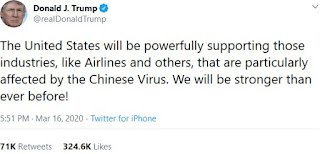
https://twitter.com/realDonaldTrump/status/1239685852093169664 “The China virus.” That’s what Donald Trump, who is always eager to shift blame, calls the coronavirus pandemic.

For example, last month, President Donald Trump tweeted that: “The United States will be powerfully supporting those industries, like Airlines and others, that are particularly affected by the Chinese Virus. We will be stronger than ever before!”

Okay, sure. The virus is widely believed to have started in China, and there’s nothing new about naming viruses after their supposed national origin: the Hong Kong flu, the Spanish flu, and so forth.

But “China virus” is more than a name to President Trump. “China virus” underlies President Trump’s coronavirus strategy (or lack thereof). By talking about the “China virus,” in one masterful swoop of deception and deflection, Trump simultaneously appeals to his xenophobic voters, deflects blame, and – this last deception is especially brilliant – gives his many critics something to complain about other than his incompetence. The “China virus” is the verbal meme that puts Trump in control of the public health agenda.

In the meantime, United States has, as of this writing, suffered 66,760 of the 245,531 of the confirmed coronavirus deaths, about 27% of the total, while the United States’ population is only about 4.25% of the world population. Prima facie, something is going very wrong with the American coronavirus public health response.

Indeed, Trump’s legendary incompetence manifests itself everywhere you look:
  • Trump asked his science advisors whether it would be beneficial to inject household disinfectants into coronavirus patients. Really? Yes, he did.
  • Trump suggested shining bright ultraviolet light into coronavirus patients.
  • Trump promised that the United States would soon be able to administer 5 million coronavirus tests a day. Of course, that capacity does not exist and he soon backtracked, calling the story a “media trap.”
Why Didn't Dr. Birx and Acting Under Secretary Bryan Speak Up Loudly Against Bleach Injections and UV Light Treatments?


Injecting bleach into patients and promising medical tests that never materialize in the promised numbers won’t stop the coronavirus pandemic. President Trump therefore could choose between two alternatives: (1) he could take effective public health actions to reduce the pandemic’s farms, or (2) he can shift the blame elsewhere. Alternative (1) would require administrative and leadership skills. Since President Trump has, so far, manifested few administrative skills, his only remaining choice is to shift the blame. China fills the bill just fine: the virus probably originated in China; China is a dictatorship with a morally questionable government, and China did, in the early days of the virus, conceal how bad things really were. That is, as we will see, pure diversion on Trump's part: even if China truly was as bad as he says, that does not excuse his own mistakes.

So, let’s look at Trump’s “China virus” rhetoric.

First, one of Trump’s major themes was that he restricted immigration from China. For example, in the April 22, 2020 Coronavirus Task Force Press Conference, Trump said:
“Plus, we put the ban on so much earlier. When Nancy Pelosi, as an example — you don’t say this — when she’s having her rally in San Francisco — in Chinatown, in San Francisco. Nobody wants to say that. If we didn’t — and Dr. Fauci said this — if we didn’t close our country to China, we would have been so infected, like nobody’s ever seen.”
Since (according to Trump), the virus was China’s fault, stopping immigration from China should (according to Trump) have stopped the virus. Focusing on the false claim that Democratic leader Nancy Pelosi held a big rally in Chinatown sharpened the contrast between Trump, who opposes China, and Pelosi, whom Trump attacked.

At a White House business roundtable on April 29, Trump acknowledged the pandemic’s enormity, but blamed it on others, including China:
“Look, this thing will pass. And when it passes, that’ll be a great achievement. And we — we’ve done a very good job. It’s far too many people, needlessly, because it could have been stopped at the point of origin. And somehow we weren’t helped by — whether it’s World Health Organization or China, whoever, we weren’t — they didn’t do what should have been done.”
Not his fault, he said, but the World Health Organization or China (or maybe both, since he wasn’t clear) was to blame. Notice the vagueness: “somehow we weren’t helped.” A week earlier, Secretary of State Mike Pompeo had accused the WHO of being subservient to China: “We know that the leader of that organization traveled to China and then declined to declare it a pandemic until everyone in the world knew that was already true,” so Trump was tying together a collection of China-related accusations.

At her first White House press briefing, newly minted Press Secretary Kayleigh McEnany dealt with the press question about China and the coronavirus by accusing China of having "mishandled the situation:"
“Q The markets are down super substantially today after the President yesterday suggested in the East Room that he might use tariffs to punish China over the coronavirus. Is there any serious consideration being given to putting new tariffs on China, or was the President just spit balling yesterday?
“MS. MCENANY: Look, I won’t get ahead of any announcements from the President, but I will echo the President’s displeasure with China. It’s no secret that China mishandled this situation.”
First, Trump’s rhetoric has long centered, above all, in what stage magicians call misdirection. If he can divert attention to China’s failures, which were certainly real, he can get his supporters to think less about his own failures, which were also real.

More about Trump and Misdirection: Trump's Twitter Speech: Lots of Talking Points, No Content

Second, Trump’s xenophobic rhetoric appeals to xenophobic members of his voting base. As Eliza Relman pointed out last year out in Business Insider, “Since the earliest days of his presidential campaign, Trump has inflamed tensions over race and immigration.”

Third, every time mainstream persons in media outlets complain about Trump’s China xenophobia, they accomplish little other than to reinforce the xenophobia of Trump supporters. This morally obtuse boomerang effect is Trump’s evil superpower. And the mainstream media never seem to get it. So, when the Huffington Post’s George Zornick writes, “giving voice to a hateful blame game that has been simmering among hardcore right-wingers for weeks,” he is completely right. But the simple fact that he pointed it out becomes, to Trump's supporters, more evidence that Trump is baiting liberals.

In other words, baiting liberals works. Baiting liberals puts Trump in charge. Every time someone like Relman or Zornick correctly points out that Trump’s rhetoric is hateful and bigoted, they are burning oxygen that could be used to attack the incredible weakness of Trump’s policies. Yes, Trump's xenophobia is evil, and it is right to criticize it. But Trump’s persuasive technique centers on spewing out so many outrageous comments that critics, fact checkers, and respectable people can’t keep up with the torrent. Saying cruel and bigoted things – and talking about the “China virus” is, bad as it is, far from the cruelest – does not harm Trump's standing among his base voters. The Republican base and undecided voters would be much more likely to care about Trump’s weak coronavirus response. By blaming it all on China, Trump diverts attention from his own failures, appeals to his base's  xenophobic views, and distracts mainstream commentators from talking about his policy mistakes.

Inspired by Trump's strategy, a Republican consulting group distributed a 57-page memo urging Republicans to attack China's coronavirus policies from every angle, giving them an alternative to defending Trump's obviously indefensible policies.

I have written several times that the winner of the debate is the side that controls the agenda. Trump is saying many things that are wrong, but the agenda is all his.