Showing posts with label Voting Rights. Show all posts

Sunday, March 8, 2026

Susan B. Anthony's Famous Speech about the Right to Vote

Susan B. Anthony
In 1870, Susan B. Anthony said that women were people, too, just like men, and she accordingly voted in an election. The legal system called this a crime and had her arrested. 

Anthony then gave a speech to argue that the United States Constitution combined with simple logic to require that women had equal voting rights. Cleverly citing conservatives’ favorite arguments against them, she laid out a convincing, value-laden case for women’s right to vote. She used the nation’s deepest traditions to support her point. She insisted that the United States should live up to its noble values. Using the same legalistic strategy that Abraham Lincoln had mastered, she defined her argument in traditional terms.

Abraham Lincoln and the Definition of “Liberty:” A Lesson for Our Time

To start that process, Anthony quoted the entire preamble to the United States Constitution:
“We, the people of the United States, in order to form a more perfect union, establish justice, insure domestic tranquility, provide for the common defense, promote the general welfare, and secure the blessings of liberty to ourselves and our posterity, do ordain and establish this Constitution for the United States of America.”
Then, Anthony reminded her audience that the Constitution did not give rights only to males, but to people:
“It was we, the people; not we, the white male citizens; nor yet we, the male citizens; but we, the whole people, who formed the Union.” [italics added]
Continuing her constitutional argument, Anthony claimed that preventing women from voting (since women are defined as people!) violated the Constitution on multiple grounds:
“For any state to make sex a qualification that must ever result in the disfranchisement of one entire half of the people, is to pass a bill of attainder, or, an ex post facto law, and is therefore a violation of the supreme law of the land. By it the blessings of liberty are forever withheld from women and their female posterity.”
Here, Anthony assumed that her audience was aware that the United States Constitution specifically outlawed the bill of attainder and ex post facto laws.

Pursuing definitions further, Anthony noted that conservatives like to call our system of government a republic, not a democracy. Turning the tables against that position, Anthony argued that those who restricted women’s right to vote wanted neither a democracy nor a republic. Indeed, she denied that those people supported any part of our system of government:
“To them this government has no just powers derived from the consent of the governed. To them this government is not a democracy. It is not a republic. It is an odious aristocracy; a hateful oligarchy of sex.”
Then, reducing her opponents’ argument to absurdity, Anthony insisted that to deny the right of vote required her opponents to deny that women are persons. Surely, she noted, not even they would sink that low:
“The only question left to be settled now is: Are women persons? And I hardly believe any of our opponents will have the hardihood to say they are not. Being persons, then, women are citizens; and no state has a right to make any law, or to enforce any old law, that shall abridge their privileges or immunities.”
In this short, brilliant speech, Susan B. Anthony insisted that the United States should live up to the noble values that its founding documents stated but often ignored. Using the same legalistic strategy that Abraham Lincoln had mastered, Anthony defined her argument in traditional terms. Perhaps the most powerful persuasive technique of all is to accept your opponents’ own arguments, and then show that they actually support your side, not theirs.

Fannie Lou Hamer's Voting Rights Speech, "Sick and Tired of Being Sick and Tired"

As the United States of America celebrates Women’s History Month in March 2026, let us pause to remember, not only women’s many accomplishments, but also the endless struggle for the equality of all women and all persons. As politicians today try to adopt the so-called SAVE Act, which tries to improve voting security but imposes greater paperwork requirements on married women’s voting rights than on men’s, let us remember that the only thing separating us from freedom is a moment of tyranny.

by William D. Harpine
______________

Research Note:

First, the appeal tradition is not necessarily a fallacy; it depends on the tradition. Some traditions are good and some are bad. Although some things that used to be good have grown obsolete, other old things remain the best. Anthony’s argument was that the people who oppose women’s voting pretended to be traditional when they had, in fact, rejected United States of America’s traditional values. It is a powerful argument.

Second, the debate strategy of reductio ad absurdum uses the simple tactic of taking a seemingly reasonable argument to its logical conclusion. This classic technique can prove that things that only seem to be reasonable are in fact faulty. Anthony applied that strategy to perfection.

For more about fallacies, there is still no better source than the work of philosopher Howard Kahane, Logic and Contemporary Rhetoric, which I often used as a textbook in my debate classes.

To understand the power of arguments from definition, one must study the great conservative rhetorical theorist Richard Weaver, especially his groundbreaking work, The Ethics of Rhetoric.


Copyright © 2026 by William D. Harpine

Image of Susan B. Anthony, public domain, via Wikimedia Commons


Saturday, January 22, 2022

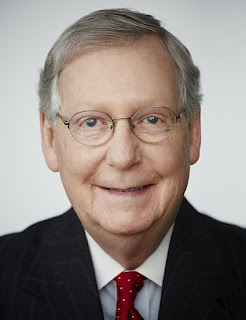
Mitch McConnell and the Art of Dog Whistles

Mitch McConnell
Mitch McConnell and the racist dog whistle ride again. In political rhetoric, a dog whistle is a statement that can say something different to different audiences. That is like the way that a dog might hear a whistle that a person cannot. Asked during a recent press conference about the concerns that people of color felt about voting rights in the United States of America, Senate Minority Leader Mitch McConnell said this:
“Well, the concern is misplaced, because if you look at the statistics, African American voters are voting in just [as a] high percentage as Americans. A recent survey 94% of Americans thought it was easy to vote. This is not a problem.”
Of course, “this is not a problem” is the conservative mantra. If you pretend that nothing is wrong, you can pretend that you don’t need to change. By falsely denying that voter suppression is real, McConnell could pretend to justify his anti-voting rights agenda.


Dog-Whistle Speech

Politicians speak in dog whistles so they can deny what they themselves say. In this case, McConnell could deny that there was a problem in the same breath that he helped to cause the problem. Similarly, one might recall that former President Ronald Reagan talked about “young bucks and “welfare queens.” Everyone knew that he was talking about African Americans. Still, since these were dog whistles and not explicit statements, Reagan could blithely deny any racist intent. His racist core voters got the idea. Yet, the proverbial suburban housewives could pretend they heard no racist content. Likewise, when King Henry II supposedly asked, “Will no one rid me of this turbulent priest?” it didn’t sound like a solicitation to murder. It was a deniable dog whistle.

McConnell’s dog whistle itemized a racial divide. His critics jumped on the obvious. McConnell distinguished between “Americans” and “African Americans.” Otherwise, he could have said that African Americans vote at the same rate as other Americans. That would have been untrue, as we will see in a moment, but it would acknowledge that Black people are Americans. Instead, McConnell’s words implied that African Americans aren’t Americans. A person might, in contrast, say that Polish-American voters vote at a higher (or lower) percentage than Ukrainian-American voters. That might make at least a little bit of sense. McConnell did something else. He distinguished between African-Americans and (real?) Americans.

McConnell, of course, quickly denied that he meant to do any such thing. “I’ve never been accused of this sort of thing before,” he said, “and it’s hurtful and offensive.” He then described his commitment to civil rights in the 1960s, saying that he had attended the 1963 March on Washington and that he witnessed President Lyndon Johnson signing the Voting Rights Act of 1965. He also explained that he had, over the years, hired African Americans to work in his office. This led Charles Booker to comment, “Mitch McConnell wants you to know it’s fine for him to block Voting Rights because he has Black friends.” Of course, anyone who grew up in the South in the pre-Civil Rights era – as I did – knows that “I have many Black friends” is the racist’s favorite refrain.

None of McConnell’s defensive comments about a distant past, however, explain why he opposes voting rights legislation today. So, we ask, what did McConnell really mean? To understand dog-whistle communication, we need to listen for clues as to the speaker’s real meaning. We also need to listen for what the speaker did not say. After all, what a speaker does not say can convey as much meaning as what the speaker does say.

The Golden Trump at CPAC 2021: Why Is the Christian Right Silent?

Politicians often use dog whistles to sneak in their true meanings. For example, predating McConnell’s outrageous statement, former President Donald Trump once said that “MAGA loves black people. ” That implied that Black people were not part of Trump’s MAGA crowd. Pretty much the same thing that McConnell implied.

Donald Trump Says That the MAGA Crowd Loves Black People, Except When They Don’t


Why Speak in Dog Whistles? 

Dog-whistle communication gave McConnell a clever way to speak out of both sides of his mouth. Did McConnell respond to the uproar by supporting any kind of voting rights legislation, however moderate? No. Did he specifically assert that “Yes, African-Americans are real Americans?” Not that I have heard. He defended himself, but that is not the same as denying his dog-whistle meaning. His core supporters can come away confident that McConnell sides with their opposition to civil rights. More moderate Republican voters can pretend that he was misunderstood. The dog whistle helped McConnell appeal to a bigger audience than what he could reach if he spoke clearly.

Was McConnell’s statement undeniably racist? Well, no. He did not use the N-word. He did not accuse Black people of being lazy or ignorant. His statement was obvious but deniable, which is the whole point of a dog whistle. We all know that Mitch McConnell pretends to support voting rights when he does not. Unfortunately, because of his tricky way of speaking, it’s hard to prove. Yet, how can we solve our nation’s problems if we can’t even acknowledge them?

Scholars sometimes call dog-whistle speech “multivocal communication.” What that means is that a single statement can mean different things to different audiences. In this case, “African American voters are voting in just as high a high percentage as Americans” carries at least two meanings. It can mean that African-American voters and American voters are two different groups. It also could mean that McConnell found a statistical equivalence between the voting rates of White Americans and Black Americans. The first implication is much more racist then the second – not that either is defensible. 


Fact Check: Was McConnell Right? No.

By the way, did McConnell have his facts right? Of course not. The United States Census Bureau found that 71% of qualified white voters voted in the 2020 election. This is substantially more than the 63% voter turnout rate of African-Americans.

What about my own experience? I have lived in the voter suppression states of South Carolina and Texas since 2005. The most recent scandal results from Texas’ new voter suppression law, which restricts mail-in ballots. When you fill in the mail-in ballot application, you need to write down your driver’s license number, your voter ID number, or the last four digits of your Social Security number. However, what if you originally registered to vote, maybe years ago, using your voter ID number, and yet put your driver’s license number on the application?  Or vice versa? The application will likely be rejected. Rejected applications need to be refiled. There is no guarantee of success, since the state’s voter records are a mess. Or, when I lived in South Carolina, voting locations changed willy-nilly, often with no notice to voters. These are just two of the 19 states that have proposed or adopted aggressive voter suppression laws. Yes, contrary to Mitch McConnell, some states pull nasty tricks to suppress voter turnout.

And, since voter suppression is patently unjust, politicians like McConnell speak in dog whistles to conceal or distract. It did not work this time. Often enough, however, it does.   
_________________

Other examples of dog whistle speech:

Were Trump’s Tweets Racist? They Were (Sort of) Deniable Dog Whistles

“And This Is Their New Hoax:” Donald Trump’s Six Deadly Words Still Ravage Our Nation
_________________

Research note: Interested readers will want to look at Bethany Albertson’s important article to learn more about multivocal communication.

Image: Congressional photo, via Wikimedia  

Sunday, March 28, 2021

Fannie Lou Hamer, "Sick and Tired of Being Sick and Tired," Gave a Voting Rights Speech in Narrative Style

As Women’s History Month comes to a close, let’s remember the influential voting rights speech that Fannie Lou Hamer presented in Harlem, New York on December 20, 1964. She shared the platform with civil rights leader Malcolm X.

Although she had little formal education, Hamer skillfully used a public speaking technique called the narrative style. Her point was that the nation had a problem. A radical organizer might have called this a consciousness-raising speech. For, once one admits out loud that there was a problem, the solution – racial justice – becomes obvious.

Hamer’s simple thesis was that the United States had a values problem.  She put it like this near her conclusion: “And I’ve been tired so long, now I am sick and tired of being sick and tired, and we want to change.” She didn’t, however, prove her point with logic. In narrative style, a speaker doesn’t present an argument like this:

“I believe that X, Y, and Z because the following evidence and proof show that I am right…”

No, instead, in the narrative style, a speaker tells a story, and the audience draws a conclusion from the story. And narrative is less like a debater’s proof; it is more a matter of telling a story that gives a moral or lesson. Sometimes the speaker states the lesson out right, and sometimes the speaker lets the audience figure out what the point is for themselves. In her speech, Hamer told her story and pounded the lesson into her audience as if she were wielding a sledgehammer. 

Starting in her second paragraph, Hamer started her story:

“It was 31 August of 1962, the 18 of us traveled 26 miles to the country courthouse in Indianola, Mississippi, to try to register to become first-class citizens. It was 31 August 1962, that I was fired for trying to become a first-class citizen.”

That’s quite a narrative hook, isn’t it? And she didn’t say “register to vote.” She said, with incisive word choice, “try to register to become first-class citizens.” She continued her story:

“When we got to Indianola on 31 August 1962, we was met there by the state highway patrolmen, the city policemen and anybody – as some of you know that it worked in Mississippi, any white man that is able to wear khaki pair of pants without them falling off him and holding two guns can make a good law officer.” 

She then explained to taking the literacy test that was required for her to register to vote. She reported that the test had 21 questions. One of them asked “by whom are you employed – so we can be fired by the time we get back home.” She then had to copy and narrate an explanation of part of the state constitution. 

"The Law Can't Change the Heart, but It Can Restrain the Heartless:" Martin Luther King, Jr. 


After not being allowed to register, she explained that she traveled back home, only to discover that she had already lost her job. She then took refuge in a friend’s home only to find that:

“On 10 September 1962, 16 bullets were fired into the home of Mr. and Mrs. Robert Tucker, where I’d been living after I was fired from this plantation.”

She then hold how the FBI swarmed the community without managing to make a single arrest. She narrated how she later traveled to a voter education conference, when “a man jumped out of his car and said, “you are under arrest.” When she arrived in her jail cell, an officer asked where she was from, and she said she was from Ruleville. The officer said, “You’s from Ruleville all right and we are going to make you wish you was dead.” In matter-of-fact style, she explained that she endured several beatings, with one man replacing another when the first became too exhausted from swinging a blackjack at her. The beating left her with permanent injuries. 

Her story was spellbinding. She then responded to the old excuse that racial justice will take time:

“And you can always hear this long sob story: ‘You know it takes time.’ For three hundred years, we’ve given them time. And I’ve been tired so long, now I am sick and tired of being sick and tired, and we want a change.”

That was not the only excuse she refuted. When people want to pretend they are not doing evil, they tell lies. Hamer would have none of that:

“The truth is the only thing going is to free us. . . .  If we want America to be a free society we have to stop telling lies, that’s all. Because we’re not free and you know were not free.”

Her only proof was her story. However, everyone listening – and everyone reading her story today – knows perfectly well that her story could be told thousands of times over. That is what gave it power. That is what made it convincing. We all know that she did not suffer injustice alone. That is why her conclusion could take a broad sweep: 

“But this is something we going to have to learn to do and quit saying that we are free in America when I know we are not free. You are not free in Harlem. The people are not free in Chicago, because I’ve been there, too. They are not free in Philadelphia, because I’ve been there, too and when you get it over with all the way around, some of the places is a Mississippi in disguise. And we want a change.”

Decades later, after citing some poorly-informed statistics, Supreme Court Chief Justice John Roberts said that the South has changed. Well, of course, in many ways it has. African-Americans are no longer routinely arrested and beaten half to death just for trying to register to vote. Nevertheless, the sweeping voter suppression laws being proposed, and sometimes passed, around the nation show that many white people still fear minority votes. Fannie Lou Hamer’s battle is not over. We should take care to remember her story.

We human beings are not really all that logical. A good story can convince people faster than any kind of logical argument.


Research Note: For more information about the narrative method of persuasion, this article by Walter R. Fisher is a good place to begin.  

More about Fannie Lou Hamer