Thursday, June 14, 2018

VP Mike Pence Mixed Religion & Politics at the Southern Baptist Convention

VP Mike Pence, official WH photo
Vice President Mike Pence delivered a political speech yesterday at the Southern Baptist Convention Annual Meeting. He continued the conservative movement's tradition of claiming biblical authority for conservative policies. On the one hand, this is old news: politicians often claim religious endorsement for their policies. On the other hand, conservative politicians are increasingly linking specific conservative policies with religion. This is something new: for neither the Christian Bible, nor any other religious authority with which I am familiar, claims that gun rights, hostile policies toward immigrants such as denying asylum, separating families, or expelling long-time residents, or the building of large military forces have a religious basis. Since he had no religious argument to make, Mr. Pence instead used the simple rhetorical device of juxtaposition: he put unrelated things side by side, creating the impression that the unrelated things belonged together.

We have increasingly seen political candidates appearing at religious conferences, giving lip service to religious ideas, then promulgating partisan views. The religious conference soon transmutes into a thinly-veiled political rally. Donald Trump has done this several times, for example, in his dramatic speech at the Values Voters Summit.

Never underestimate the rhetorical or persuasive power that comes when people combine religion and politics. This is nothing new; European rulers claimed the "divine right of kings," while, today, oppressive dictators in the Middle East claim a religious basis for their power. A citizen might argue with a seamy, scummy, amoral politician, but it takes real nerve to argue with God. A political pundit might disagree with the politician's values, but faces a real struggle by arguing with the Bible. So, when politicians lay their controversial, and often unwise, ideas side-by-side with religion, they gain credibility that they have not earned. They can shut down debate about the issues, and divert controversy from issues to unrelated values.

So, let us look at how Vice President Pence, who is widely known to be a conservative Christian, sandwiched controversial ideas in between slices of religion.

First, after acknowledging a flattering introduction, Mr. Pence introduced himself: "I'm a Christian, a conservative, and a Republican, in that order." This brief comment established his credibility: he established to the Christian audience that he was a Christian and he assured them that he put Christianity first, but then he laid conservatism and Republicanism side-by-side with Christianity. This made Christianity, conservatism, and Republicanism sound like a triumvirate of virtue. This is the power of juxtaposition.

Next, Mr. Pence praised President Donald Trump as "A leader who, I can tell you, has been delivering every day on his promise to protect faith and restore freedom across this country."  This appeals to two distinct points: first, the speaker reassured the audience that President Trump was protecting their faith against attack, while, at the same time, he repeated the concept of "freedom," which conservatives believe is also under attack. Already, Mr. Pence was mixing religion and politics together, but in a very subtle way: what Christian would argue against freedom?

Mr. Pence then talked about his upbringing, "it was grace before dinner and church on Sunday morning." He discussed his own religious conversion. He praised Southern Baptists for working "to bring about renewal of America, and new beginnings." That sounds fine, and still had a religious tone. Without a seam, he slipped into a political panegyric: "I believe that our nation is in the midst of a time of renewal," which could be either religious or political – he didn't say – and then, "we are in the midst of a new beginning of greatness in America."

So much of that is clever: a parallel phrasing – "in the midst of," and again "in the midst of" – connected a secular idea back to a religious one. When a speaker phrases two different ideas the same way, this can lead the audience to think that the ideas belong together. Also, Mr. Pence placed the religious and non-religious ideas side by side. Religious renewal, which most Protestant believers would favor, united with Donald Trump's controversial political policies. Mr. Pence did not tell the audience that Mr. Trump's ideas were religious, which they obviously are not; instead, he just lumped the two points together.

The link between religion and conservative politics, which Mr. Pence had already hinted at, became crystal clear in the next paragraph:


"When you look at the progress we’ve made over the last 500 days, at home and abroad – the stronger America, a stronger economy, a stronger commitment to the God-given liberties enshrined in our Constitution – I think there’s only one way you can sum up this administration: It’s been 500 days of action, 500 days of accomplishment.  It’s been 500 days of promises made and promises kept.  (Applause.)"

The speaker's transition from religion to conservative politics was now complete. "Stronger America?" Where does the Bible say that? "Stronger economy?" The Bible is strangely silent about macroecnomic policy. "It’s been 500 days of action, 500 days of accomplishment.  It’s been 500 days of promises made and promises kept:" Mr. Pence's humble confession of faith had now become open boasting about political accomplishments.

With the political engine now running at full power, Mr. Pence now said:

"From the very beginning of this administration, we’ve been rebuilding our military, restoring the arsenal of democracy.  And as the proud father of a United States Marine, I couldn’t tell you how grateful I am that, with the support of this Congress, we are once again giving our soldiers, sailors, airmen, Marines, and Coast Guard the resources and training they need to accomplish their mission and come home safe.  (Applause.)"

The speaker had wandered away from religion and baldy praised the administration's pro-military policies. He continued by boasting of strict law enforcement:

"We’ve been standing with the courageous men and women of law enforcement.  We’ve been securing our borders, enforcing our laws, and removing dangerous criminals, drug dealers, and gang members off our streets in record numbers.  (Applause.)"

This, again, is political. Mr. Pence then endorsed "the President's stand on 'peace through strength.'" Again, although most conservatives, and many liberals, favor strength, this was a purely non-religious policy. He then moved on to a strictly pro-American (not pro-Christian) policy: "President Trump has been putting America first and standing strong for America’s interests all over the world." Many Americans will think that is a good political policy but it has no religious foundation.

Yet, returning to his religious theme, Mr. Pence contradicted himself: "In this White House, I want to assure you, we know that America’s strength ultimately comes from the foundation of our most cherished values in this country." So, which is it: does strength come from armies? Or from values? Which comes first? Mr. Pence seemed to want it both ways. He then finished the speech by discussing several more faith issues. That helped him sandwich his partisan ideas into a religious context.

Many people would argue with President Trump's policies. Fewer would argue with the Bible. Mr. Pence set up a high burden for Mr. Trump's opponents: to contradict President Trump is to contradict religion.

Liberal politicians would be wise not to take the bait. Mr. Pence advocated many policies that lack religious foundation. He put those policies side-by-side with religious values. But they don't necessarily fit. Christianity does not justify peace through strength, high tariffs, or conservative macroeconomic policies. Mr. Pence put conservatism and religion side by side to shut down reasoned, evidenced debate about controversial policies. This is not a legitimate rhetorical tactic.

Please note that I'm not saying whether Mr. Pence's policies are right or wrong. I'm saying that they aren't religious, but, that by putting his policies side-by-side with religion, he made them sound religious. Does Christianity support conservative policies? What about feeding the poor, visiting prisoners, helping the helpless, and forgiving wrongs? 

A hidden danger lurks: did Vice President Pence equate being religious with being Christian? Did he equate being Christian with being a Republican? Although Christianity is my own religion, I don't feel comfortable with any of that.

Later, I'll discuss audience reactions to Mr. Pence's speech. Not everyone at the meeting liked his strategy. Not everything went according to his plan. Stay tuned!

If you would like to post  a comment, log on to your Google account. Comments are moderated. 

See my earlier post about Dr. Robert Jeffress' speech in Jerusalem, which used the same tactic. 

Wednesday, June 13, 2018

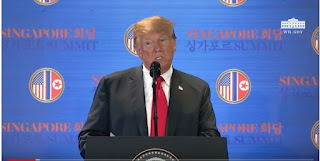
President Trump's News Conference about the North Korea Summit - "Word Salads" and the Art of the Vague Deal

Trump's News Conference, June 12, 2018
President Donald Trump held a news conference yesterday to make a statement and answer questions about the Singapore Summit meeting between him and North Korean leader Kim Jong Un. Although his meeting with the North Korean dictator has caused controversy, with both sides giving heated opinions, the news conference took a civil, positive tone and laid out the United States government's position about negotiations with North Korea. Yet Mr. Trump cleverly avoided the tough issues, leaving himself plenty of room to wiggle in the future.

All politicians get vague sometimes, especially during sensitive international negotiations.
Trump-Kim Summit
Here's the underlying issue: the brief joint statement that Kim and Trump issued really didn't promise much. The statement promised to "denuclearize" the Korean Peninsula. What that means is not entirely clear. Will all nuclear weapons be removed? What about the missiles? What kind of inspection program will verify that the weapons have been removed? What about building additional nuclear weapons in the future? What about American nuclear weapons offshore, but near North Korea? Both sides promised to engage in talks, but no timetable was released. Again, these kinds of questions commonly arise during international negotiations. Still, North Korea and the United States are long-time adversaries, and they may not share enough values and goals to reach a meaningful agreement. Time will tell. 

Now, none of this is intended to criticize the agreement, which seems like a positive first step. Let's take a look at what Mr. Trump said during his news conference, and see how little he promised, while giving the impression that he was pr0mising a lot.

Trump's Opening Statement
In his opening speech, Mr. Trump glowed about the summit: "We’re getting ready to go back.  We had a tremendous 24 hours.  We’ve had a tremendous three months, actually, because this has been going on for quite a while." He called the signed document "very comprehensive. It's going to happen." More reasonably, he continued: "I stand before you as an emissary of the American people to deliver a message of hope and vision, and a message of peace." It was reasonable to call the brief statement a message of hope, and less reasonable to call it comprehensive. He noted the historic event, that this was the first meeting between an American president and a North Korean leader. This was of course true, largely because previous American presidents were worried that such a meeting would legitimize North Korea's oppressive dictatorship.

Mr. Trump stated that "My meeting with Chairman Kim was honest, direct, and productive.  We got to know each other well in a very confined period of time, under very strong, strong circumstances.  We’re prepared to start a new history and we’re ready to write a new chapter between our nations." He expressed hope that the Korean War would soon be officially ended. He assured that "history has proven over and over again, adversaries can indeed become friends." Mr. Trump also said that Chairman Kim had promised to destroy "a major missile engine testing site," a promise that was not included in the written agreement. He did assure that the current sanctions against North Korea would remain in effect. He announced an end to joint American-South Korean military exercises, which sounds like a significant concession.

Trump's "Word Salad" Answers to Reporters' Questions

Needless to say, however, reporters wanted to know more details. The first question, which came from NBC News, addressed North Korea's appalling human rights record: "First, the man you met today, Kim Jong Un, as you know, has killed family members, has starved his own people, is responsible for the death of Otto Warmbier.  Why are you so comfortable calling him 'very talented'?" Mr. Trump pointed out that Kim had taken over his country at the age of 26, "and is able to run it, and run it tough." He expressed sympathy for Otto Warmbier, an American who died in North Korean custody. But he avoided the issue of North Korea's oppressive human rights record against its own citizens. (If you can't say something nice, apparently you don't say anything at all!)

Another question asked whether the denuclearization would be verified: "Was that a concession on the part of the United States?" Mr. Trump assured that "It will be verified." Discussing how it would be verified, Mr. Trump spoke in what conservative writer Jennifer Rubin calls "word salads." She has called Mr. Trump's word salads "babbling" and evidence that he is incompetent. I can't agree with her. The word salads are a kind of creative genius, a brilliant way to avoid answering tough questions, a way to take both sides of an issue at the same time, a way to sound intelligent while saying nothing. In a word salad, Mr. Trump dumps out of a jumble of words that seem to answer the question, but which give no information, like this:


"Well, it’s going to be achieved by having a lot of people there, and as we develop a certain trust.  And we think we have done that.  Secretary Pompeo has been really doing a fantastic job — his staff, everybody.  As we do that, we’re going to have a lot of people there, and we’re going to be working with them on a lot of other things.  But this is complete denuclearization of North Korea, and it will be verified."


The word salads represent a very clever, although ethically questionable, speech technique. Mr. Trump sounds as if he is talking about an important subject, and gives the impression that he answering thoughtfully, while actually conveying no meaning. "A lot of people there?" What does that mean? Which people, where is "there," and what will the "lot 0f people" be doing? On what basis will there be "a certain trust?" Trump's answer was actually brilliant, albeit extremely useless, because not only did he evade the question, but his rambling answer was so confusing that a good follow-up question became very difficult. 

Similarly, when asked whether he trusted Kim, a man who seems quite untrustworthy, Mr. Trump responded with another word salad:

"I do.  I do.  I can only say that I know him for — really well, it’s been very rhetorical, as you know.  I think, without the rhetoric, it wouldn’t have happened.  I think without other things going along — I think the establishment of a new team was very important.  We have a great team.  But I do, I think he wants to get it done.  I really feel that very strongly." 

What rhetoric? What is it that was "very rhetorical?" Why does he think Kim will keep his word this time, perhaps for the first time ever? What specific things did his "new team" do? Mr. Trump's answer was complex and full of big words, but empty of content.

When asked again about Kim's human rights record against his own people, Mr. Trump responded with yet another, even more incomprehensible word salad:

"Right.  It was discussed.  It was discussed relatively briefly compared to denuclearization.  Well, obviously, that’s where we started and where we ended.  But they will be doing things, and I think he wants to do things.  I think he wants to — you’d be very surprised.  Very smart.  Very good negotiator.  Wants to do the right thing."

"I think he wants to — you’d be very surprised" isn't even a sentence.  And so forth. 

I have noticed over the years that most presidents are very good at not answering the questions that are asked of them. Most often, the president gives a very clear answer to some question other than the one that was asked. In contrast, Mr. Trump's complex, evasive responses create the impression that he is answering questions directly, while, actually, he's avoiding the question just as skillfully – maybe more skillfully, than previous presidents.

When speakers have good answers, they give the answers. When speakers don't have good answers, they might punt, they might change the subject, they might stomp out of the room. They might, on rare occasions, honestly admit that they don't know the answer. Mr. Trump doesn't do any of those things. Instead, Mr. Trump sows confusion. I can't say that this is any different in principle from the ways that, for example, Lyndon B. Johnson or Richard Nixon avoided questions, but Mr. Trump's skill at mystification probably deserves awe and admiration just as much as it deserves condemnation for its fundamental emptiness.

In the meantime, Mr. Trump made it sound as if he were making big promises while preserving deniability. Sneaky? Brilliant? Dishonest? Let the listener decide. 


Images: White House YouTube channel; official White House photo via Wikimedia Commons

If you would like to post a comment, log on to your Google account

Tuesday, June 12, 2018

Student Lulabel Seitz Exercised Her First Amendment Rights--and Was Cut Off!

All over the news - Lulabel Seitz, a senior at California's Petaluma High School, gave a commencement speech in which she mentioned her sexual assault, which she said happened on school property. The school cut off her microphone before she could finish her speech.

It seems that:

1. The school specifically asked her not to discuss her sexual assault during the speech.
2. She had a prepared text, which the school approved in advance. She was told not to vary from the script.
3. She persisted anyway.
4. Later, she posted her entire speech on the Internet

Bill of Rights, National Archives
Some of her classmates shouted, "let her speak," while others thought that it was inappropriate for her to talk about her sexual assault at graduation. A case could be made either way, I suppose. However, as a former speech professor, I am a big First Amendment advocate. If she wanted to deliver a tasteful but pointed discussion of her sexual assault, I say to let her do it. She earned the right by being the best student in the school, and maybe the school should have supported her better. However:
  • Institutions always seem to defend themselves. The assault was surely an embarrassment to the school, and, if they indeed handled it poorly (I have no knowledge of that one way or another, but many schools do handle sexual assault poorly), they are going to be more embarrassed. 
  • If the school had let her speak, she would have gained some attention, and might have made the school look bad.
  • By calling attention to sexual assault in schools, Seitz performed a service. Public officials usually don't improve unless someone forces them to do so. 
  • When they cut her off, Seitz got on the national news, and hundreds of thousands of people watched her full speech on YouTube. So, the school's attempt to cut her off was a big, counterproductive failure. As usual. 
  • A basic principle of public relations is that the truth always comes out, and coverups are always a mistake. By trying to silence Seitz in what looked like an effort to protect the school's image, the school officials just made their image worse. That was very predictable.
  • Students do not leave their First Amendment rights at the school door. The Supreme Court ruled in the case Tinker v. Des Moines Independent Community School District as follows:
"In order for the State in the person of school officials to justify prohibition of a particular expression of opinion, it must be able to show that its action was caused by something more than a mere desire to avoid the discomfort and unpleasantness that always accompany an unpopular viewpoint." Legal scholars disagree about whether the courts would consider the school to have violated Seitz' rights.

To live in a free society means that we will often be exposed to unpopular and controversial viewpoints. If Seitz's speech disturbed her classmates or school officials, well, so be it.

Of course, in the Internet Age, school officials can't avoid embarrassment just by cutting off a microphone. In an effort to avoid controversy, they just made themselves look petty.

The First Amendment doesn't exist to protect powerful people or public organizations (like schools!). It exists to protect people who want to stir things up.


Note that I have previously posted about the importance of free speech on college campuses:
If you would like to post a comment, log on to your Google account.

Thursday, June 7, 2018

President Donald Trump Praises Islam at the White House Iftar Dinner in a Model of Political Correctness

Donald Trump at Iftar Dinner
The world of political rhetoric sometimes create strange twists and turns. Yesterday, June 6, President praised Islam during a speech in the East Room of the White House to share the Iftar Dinner with a group of Muslim diplomats. Iftar is a ceremonial dinner held to break fast during Ramadan. Controversially, few  American Muslims were invited, reportedly not even the two American Muslims in Congress.

That Mr. Trump held an Iftar Muslim dinner at all seems remarkable, given the hostility that he has sometimes expressed toward that religion. In January 2017, he complained that his own Justice Department's Muslim travel ban was too "politically correct." Mr. Trump did not hold an Iftar dinner last year, causing some public notice. While he was running for president in 2015 and 2016, opposition to Islam was one of Donald Trump's key issues. He sometimes expressed his hatred of Islam in stark and uncompromising terms. Here are a couple of examples:
  • Speaking in Mount Pleasant near the South Carolina coast in December 2015, Mr. Trump read a statement that said: "Donald J. Trump is calling for a total and complete shutdown of Muslims entering the United States until our country's representatives can figure out what is going on." The crowd of his supporters cheered.
  • In March 2016, Trump told newscaster Anderson Cooper that:"I think Islam hates us." Trump criticized what he said was the "tremendous hatred" that Islam represented. He acknowledged that there is a difference between Islam and radical Islam, but cautioned that: "it's very hard to define. It's very hard to separate. Because you don't know who's who."
In contrast, Mr. Trump's Iftar dinner speech was utterly non-controversial. His attitude was completely unifying. As you watched it or read it, you would have no idea that opposition to Islam had played such a central role in his campaign – or his presidency.

Mr. Trump began like this:

"Good evening, and thank you all for joining us — this Iftar dinner — as we celebrate the Islamic holy month of Ramadan.  It’s a great month.  A lot of friends, a lot of great friends."

Here are some complimentary things that Mr. Trump said about Islam later in his speech:

"In gathering together this evening, we honor a sacred tradition of one of the world’s great religions.  For the Islamic faithful, the Iftar dinner marks the end of the daily period of fasting and spiritual reflection that occurs throughout the holy month of Ramadan.  Iftars mark the coming together of families and friends to celebrate a timeless message of peace, clarity, and love.  There is great love." 

That does not sound like the "Muslims are coming to kill us" theme that we often hear from conservative speakers, or that is implied by Trump's recitation of a popular song that compares refugees to snakes. Later in the speech, Mr. Trump said:

"The partnership and solidarity that we established over the past year has only deepened with time.  So many friendships.  So many meetings, even in the Oval Office.  And we’ve made a lot of progress, I think, a lot of tremendous progress."

And, at the end of the speech, Mr. Trump commented: "Have a very blessed Ramadan.  Thank you very much for being here.  It’s a great honor." 

There was certainly nothing whatsoever wrong with Mr. Trump's speech. It was a model of political correctness. Ramadan is an important part of the Muslim faith, and fasting during that season is one of Islam's pillars. Mr. Trump sent a message, an anti-Muslim message, last year when he did not hold an Iftar dinner. Was he signaling reconciliation? Was he taking a chance of losing the anti-Islam portion of his base? Or was this just a clever political strategy, a chance for him to establish that he was "presidential" while announcing no change in policy? Or was he claiming credit for improved relations with Muslims? Once again, we need to ask: "Will the real Donald Trump please stand up?"

Image: White House YouTube channel

If you would like to post a comment, log on to your Google account

Tuesday, June 5, 2018

The Audience Responds Ideologically to Ben Bowling's Bell City High School Graduation Speech

Most graduation speeches are boring, but some of them have zingers, like this one or this one. Ben Bowling, valedictorian of Bell City High School in Pineville, Kentucky, shot out a really good zinger, reported on Fox News and other major national media.


During his speech, Bowling quoted Donald Trump: "Don’t just get involved. Fight for your seat at the table. Better yet, fight for a seat at the head of the table." Wow! The crowd cheered. This was, after all, rural Kentucky - Trump Country Central. He then revealed that the quotation actually came from former President Barack Obama. He delivered the line in his 2012 commencement speech at Bernard College. The crowd fell silent; some audience members booed.

Let's parse out the audience's response.

1. The audience was obviously partisan. When the audience thought that their man, Donald Trump, made the statement, they thought it was great. They didn't like hearing that Obama had said it. The statement was the same either way, and equally true either way.

2. We have known ever since the 1948 Elmira, N.Y. studies that party affiliation is the single best predictor of how people will vote. People will change their attitudes and beliefs to conform to their party far more often than they will change their party to affirm their beliefs.

3. Linguist George Lakoff says that conservatives work with a strict father metaphor. They want leaders who will be strong and powerful. Liberals prefer leaders who are supportive and nurturing. But Obama's quotation conveyed strength: "Fight for your seat at the table." I presume that the crowd liked hearing that their man, Donald Trump, said something to show strength. But Obama? Many conservatives do not believe that any Democrat could ever be a strong leader. Many conservatives feel that Obama was weak. Interestingly, one reader's comment about Bowling's speech on USA Today said that: "That doesn't sound like something a socialist/regressive/neosocial liberal would say...more like cry about how you're a victim to get your seat at the table." In other words, some people don't accept truth if it conflicts with their preconceived opinions. If it is an article of faith that Obama is weak, it becomes unthinkable that he could have said something strong.

4. So, politically speaking, what seemed to have happened was this: the crowd liked Trump, and liked that he projected strength. They didn't like Obama. For Obama to express strength left them confused. How, they must have thought, could Obama be strong? That must have made no sense. How could Obama even have said such a thing?

5. Many people view politics as a zero-sum game: some groups win; some lose, and to win you must crush the opposition. For Trump to express strength, and, by implication, to promise the poverty-stricken Pineville community a seat at the table, probably sounded good. But for Obama to bring his supporters to the table? That probably sounded bad. When we think in a partisan way, we stop ourselves from seeking win-win solutions. A Leo Cullum New Yorker cartoon shows two dogs sharing a drink at a bar; one of them says, "It is not enough that we succeed. Cats must also fail." Such is partisanship.

Young Ben Bowling made a good point. Maybe he got his audience to think more about partisanship. Maybe he got them to think that the other side is worth hearing. Maybe he just irked some of them. But it was a great moment in public speaking. In any case, #BenBowling is all over Twitter. Bell City HS Principal Richard Gambrel commented that the incident "proves that people don't read or pay attention." Indeed!

All in all, I think we have too much ideology - and too much partisanship. Both of those evils keep us from seeing what is true. They stop us from seeing our common goals. They stop us from loving one another. They stop us from working together.


If you would like to post a comment, log on to your Google account.  All comments are moderated. 

Image: Barack Obama preparing to speak at Barnard College commencement exercises; White House photo.