Showing posts with label economics speech. Show all posts

Monday, September 7, 2026

Huey Long and the Populist Moment

Huey Long
“You cannot let any man own $300,000,000,000 or $400,000,000,000. If you do, one man can own all of the wealth that the United States has in it.”
Thus, Huey Long, United States Senator from Louisiana, giving his national radio speech of February 23, 1934, stated populism’s basic principle. Although the populist movement has since morphed onto oddly contradictory paths, including Donald Trump’s trickle-down populism for the rich, Long himself proposed populism (literally, “of the people”) to promote ordinary people. Long defined his movement as “every man a king” or “share our wealth.” Blaming the elites for their greed and the economic system for brazen unfairness, Long asked for the nation to redistribute its wealth.

In 1934, the United States and, indeed, the world, roiled in turmoil. The world’s economy was collapsing. Unemployment ranged to an astonishing 23%. Many people even felt that the four-year-old Great Depression represented the collapse of the free enterprise system. Horrified Americans watched desperate nations respond to the crisis by turning to cruel dictatorships, left and right wing alike, in Germany, Hungary, Italy, Portugal, Russia, and Japan. Instead of pursuing such extreme responses, Long envisioned an audience that wanted to preserve constitutional government even though that government had failed them. Feeling that President Franklin Roosevelt’s New Deal program was falling short, Long offered a more dramatic economic reform.

Long had risen to fame in Louisiana, a state that was, then as now, dominated by extreme conservatives. Yet, Long broadcast his radio speech to the entire nation, not just to his own state. He took a broad approach that offered radical solutions tucked into a conservative frame. This helped him speak, not just to one faction, but to all working Americans. Furthermore, Long appealed to conservatives’ propensity for grievance. Unlike, say, Robert LaFollette or Clarence Darrow, Long did not present himself as a progressive (although his economic ideas were progressive in the extreme). Instead, he asked the nation to return to tradition. Back to the old ways! Back to a (perhaps imaginary) past when the nation served its workers, not its elites! Long’s populism proposed a vision: to rebuild economic justice that had been lost.

Would the same tactic work today for the aggrieved conservative voters who supported Donald Trump, curiously framing him as a populist? I will let my readers reflect and decide.


The Appeal to Tradition and Long’s Economic Arguments

Great Depression Breadline, New York City

Long’s point about wealth inequality resonates exactly with today’s democratic socialists like Bernie Sanders and Alexandria Ocasio-Cortez. Yet, unlike many progressives, Long grounded his argument, not in the idea of progress, but in the restoration of lost traditions. That grounding underlay Long’s populist outlook.

To make his case, Long blamed, not the immigrants, not even the politicians, but the wealthy elites who wielded unchecked power to guard their own wealth:
“It is not the difficulty of the problem which we have; it is the fact that the rich people of this country – and by rich people I mean the super-rich – will not allow us to solve the problems, or rather the one little problem that is afflicting this country, because in order to cure all of our woes it is necessary to scale down the big fortunes, that we may scatter the wealth to be shared by all of the people.”
Long understood that the haves say that they deserve everything while the have-nots deserve their dire fate. Long took a brilliant hack at that complaint: he quoted the Declaration of Independence – “all men are created equal” – and asked a straightforward question:
“Did that mean, my friends, that someone would come into this world without having had an opportunity, of course, to have hit one lick of work, should be born with more than [they] and all of [their] children and children's children could ever dispose of, but that another one would have to be born into a life of starvation?”
With that searing question, Long reversed the conservatives’ pro-wealth moral argument. We should admit that, although some of the superrich do build massive businesses by hard work and insight, a great many simply inherit or embezzle their wealth and then use it to corrupt government policy to their own benefit. Simultaneously, however, Long pointed out that other people, no less worthy than a billionaire’s heirs, might be born into relentless, hopeless, grinding poverty. Did his audience think that was fair? After all, far more people are workers than are oligarchs, and, so, should populism not be their philosophy?

Continuing to pound on that insight, Long asked:
“Is that, my friends, giving them a fair shake of the dice … when we have today in America thousands and hundreds of thousands and millions of children on the verge of starvation in a land that is overflowing with too much to eat and too much to wear?”
Long thus underscored that American inheritance practices produced inherently unfair results. He drove that home with a brilliant, and not entirely inaccurate, analogy:
“… That no one man would get half of it and hand it down to a son, who takes half of what was left, and that son hand it down to another one, who would take half of what was left, until, like a snowball going downhill, all of the snow was off of the ground except what the snowball had.”
Appealing to his core group’s commitment to conservative Christianity, Long then turned to biblical law.

An earlier post traces Huey Long’s appeals to tradition:


Long’s Arguments from Religious Tradition

Long argued that biblical law not only allowed but required sharing the nation’s wealth. He reminded his listeners of the biblical Year of Jubilee which required that, every 50 years, property should revert to its original owners.

Indeed, Long insisted that redistribution was “the law of the Lord.” Furthermore, Long said that biblical law reflected an underlying value:
“We would have to distribute wealth every so often, in order that there could not be people starving to death in a land of plenty, as there is in America today.”
Long also reminded the radio audience that, according to the Hebrew Scriptures, all debts should be forgiven every seven years. He further discussed the growing problem of personal indebtedness, which was crushing Americans’ ability to function economically. This led Long to propose a religious solution for Americans’ debt:
“We have in American today, ladies and gentlemen, $272,000,000,000 of debt. Why, my friends, that cannot be paid. It is not possible for that kind of debt to be paid.”
Although those economic problems may have seemed hopeless, Long next gave an idea.


Long Proposed a Populist Solution

Understanding the importance of raising popular political support to rise against the oligarchs, Long set up a series of organizations to combat the oligarchical wealth:
“Now, we have organized a society, and we call it ‘Share Our Wealth Society,’ a society with the motto ‘every man a king.’”
Continuing, Long proposed that “we have to limit fortunes” by passing appropriate laws. Also, with Social Security still in the future, Long also supported an old age pension that would help ordinary people but, in his version, not pay the wealthy. He proposed limiting the workday and limiting production. He argued that such policies would limit the wealthy elites.
 

It Was All About Tradition

Nearing his conclusion, Long reemphasized his populist traditionalism. A progressive might shout, “Power to the People!” Long had the same idea, but phrased in conservative ideology:
“God told you what the trouble was. The philosophers told you what the trouble was; and when you have a country where one man owns more than 100,000 people, or a million people, and when you have a country where there are four men, as in America, that have got more control over things than all the 120,000,000 people together, you know what the trouble is.” 
Did Long really think that his ideas could become political reality? I believe he did, and he established a program to turn them into reality. Now, public speaking teachers often explain that people will support a policy if they organize in groups to work for it. Understanding this instinctively, Long urged his listeners to “organize your own Share Our Wealth Society” and to express their views to Congress.

Brazilian President Lula’s Populist Speech

Herbert Hoover's Ode to Freedom during the Great Depression


Lessons for Today?

Were Long’s ideas realistic? That could be debated. In 1934, the modern science of macroeconomics was still in its infancy, and it is questionable whether even the greatest experts in 1934 fully understood how to deal with the Great Depression. The financial system had collapsed and crushed the world’s economy as it fell. Even today, people who should know better (but who fear change) continue to resist the most basic macroeconomic policies. Still, Long recognized an economic problem, sympathized with working people, gave them someone to blame, and proposed a solution. Nevertheless, he offered no sympathy to the socialists. Instead, he supported his ideas by citing philosophy, American political heritage, and Judeo-Christian tradition. That brilliant approach helped short-circuit opponents who thought he sounded like a liberal. Long even took a moment to lash out at Franklin Roosevelt’s New Deal program, which, perhaps, many conservatives opposed in principle. 

So, Long did not present brilliant economics, nor incisive Bible study. Instead, he offered compelling rhetoric. Maybe Huey Long was, as his critics claimed, merely a con artist, but, if so, he was a con artist for the people. Like all good debaters, Long reset the agenda.

It is no wonder Huey Long was soon assassinated. It is also no wonder that more than 200,000 people thronged to his funeral. For, after all, populism means standing for the people. The established order had failed in 1934, and people yearned for solutions.

Somehow, I cannot reconcile Long’s version of populism (if populism still means government for the people) with President Donald Trump’s faux populism, which offers massive breaks to the wealthy. While Huey Long favored direct wealth redistribution, Trump relies more on the conservative’s usual trickle-down theme, holding that business growth will eventually improve workers’ lives. So, Trump’s speeches feature populist themes with a big-business twist: “I’ll be reducing taxes tremendously, from 35 percent to 15 percent for companies, small and big businesses. That’s going to be a job creator like we haven’t seen since Ronald Reagan. It’s going to be a beautiful thing to watch.”

At the same time, however, although Long’s Share Our Wealth theme was far more radical than anything that today’s progressives suggest, he sold himself as a moral traditionalist. Long’s populism spoke for the people, for religion, and for old-time American goals. In a larger sense, faced with the Great Depression, Long sought, not to destroy capitalism, but to save it—to rescue it—and the nation—from its excesses. So, in Huey Long’s dramatic radio address, the United States heard a literal populism of the people.

I write this post on the United States’ Labor Day holiday 2026. On this day, we still face Huey Long’s ancient question: are we fair to the laboring people?

by William D. Harpine    

__________

P.S. Women had the vote in 1934, so what was Long’s purpose in making “every man a king?” That was no surprise. Louisiana did not ratify the 19th Amendment, which recognized women’s right to vote, until 1970.

By the way, both of my parents grew up during the Great Depression. My father was fortunate, in that my grandfather was a successful small-city businessman. The family lived in a large, beautifully furnished house just outside Harrisonburg, Virginia, drove a good car, and never knew hunger. Desperate hobos who rode the rails looking for temporary work knew that my grandmother was always good for a sandwich. In contrast, my mother’s parents were poor immigrants. Her father worked as a carpenter in a Pennsylvania steel mill, while her mother sold eggs. The mills were not yet unionized in 1934, and life could be hard. Still, luckily, none of my grandparents ever faced unemployment. 


Research Note

There are several excellent studies of Huey Long’s speeches. Professor Michael J. Lee’s 2006 fascinating essay in The Quarterly Journal of Speech, “The Populist Chameleon: The People's Party, Huey Long, George Wallace, and the Populist Argumentative Frame,” points out that different political philosophies have called themselves populist, with such common themes as identifying an enemy (wealthy people, big business, big government, or whatever) and promising restoration to the old ways.

The article lurks behind a paywall, but many large libraries can find an online copy for you. Also, your local library might have any number of biographical books about Huey Long. One can also watch Hollywood-style movies of varying accuracy about Huey Long.


Copyright @2026 by William D. Harpine


Image of Huey Long, public domain, via Wikimedia Commons

Image of Breadline, United States National Archives, via Wikimedia Commons

Saturday, August 26, 2023

Federal Reserve Chair Jerome Powell Explains Inflation Policy

Jerome Powell
Although most people ignore it, the Jackson Hole summit, sponsored by the Federal Reserve Bank of Kansas City, always commands the financial community’s breathless attention. Federal Reserve Chair Jerome Powell spoke yesterday on the topic, “Inflation: Progress and the Path Ahead.”

Disregarding the fevered riots of political controversy, Powell gave a calm, reasoned, and technical economic speech. He explained the causes of inflation and the Fed’s plan to control it. His thesis was that economic decisions should be driven by data. His unspoken point was that the Federal Reserve operates with information, not by politics. (I wish that more decision makers would live by that rule: instead of looking for ways to scream about the political opposition, shouldn’t we pay attention to the facts?) Powell toned down the public’s expectations and presented factual, expert analysis in this critical but low-key speech. Powell’s speech was very much not designed to attract massive public attention. Instead, he sought to clarify policies and calm fears in a speech designed for the consumption of specialists.

The Federal Reserve, of course, operates under a dual mandate: to keep inflation and unemployment alike at reasonable levels. Any economics student knows that those two goals often clash, and Powell examined them with great care.

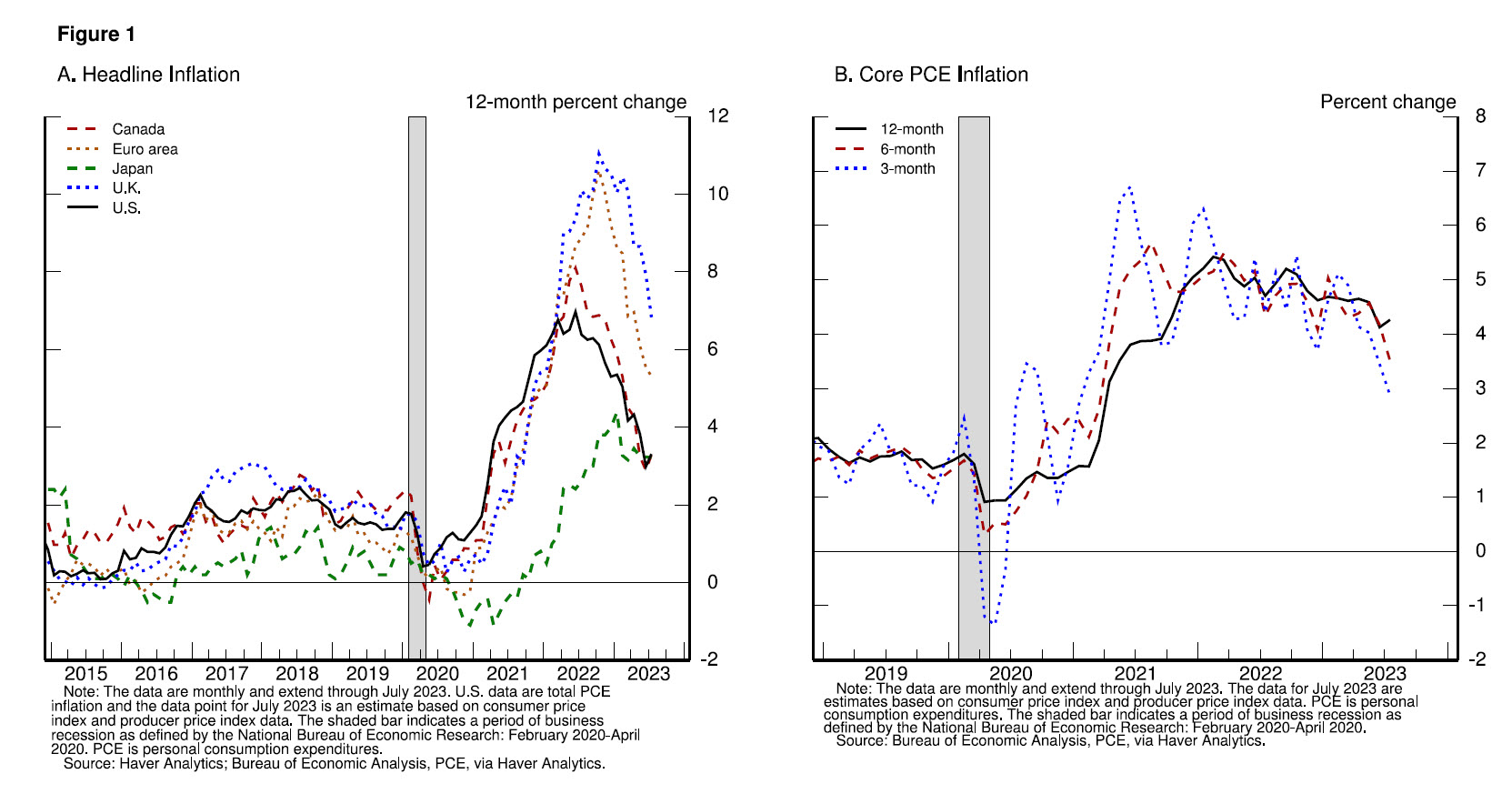
So, in this speech, Powell attributed recent inflation to factors like the war in Ukraine, “unprecedented pandemic-related demand and supply distortions,” and Federal Reserve policies. Noting that energy and food prices are inherently volatile, Powell focused instead on core inflation. His explanation bulged with numbers, for example:
“On a 12-month basis, core PCE inflation peaked at 5.4 percent in February 2022 and declined gradually to 4.3 percent in July.”
Powell supported that claim with this informative but complex slide, which, no doubt, invigorates the thoughts of financial experts even as the public’s eyes glaze over:


Nevertheless, Powell also warned that the economic picture remains unclear and that more work needs to be done to control inflation:
“We can’t yet know the extent to which these lower readings will continue or where underlying inflation will settle over coming quarters. Twelve-month core inflation is still elevated, and there is substantial further ground to cover to get back to price stability.”
Powell also explained that the dual mandate would require the Federal Reserve to restrict economic growth to keep inflation down to the 2% target rate:
“Getting inflation sustainably back down to 2 percent is expected to require a period of below-trend economic growth as well as some softening in labor market conditions.”
No matter how good your data might be, of course, no one can actually predict the future. In that vein, Powell literally waxed poetic about the need to rely on precise, exacting, but always uncertain data analysis:
“As is often the case, we are navigating by the stars under cloudy skies. In such circumstances, risk-management considerations are critical. At upcoming meetings, we will assess our progress based on the totality of the data and the evolving outlook and risks.”
Given the complexities of economic judgment, combined with politicians’ eagerness to confuse the issues with screaming lunacy, the Federal Reserve is, at least in theory, above politics as it tries to guide the economy in a sound direction. Obviously, economic decision making also requires informed, responsible action by Congress. Sadly, we could lose a lot of sleep expecting something as chimerical as that to happen.

The problem with expert data analysis is that only experts can readily interpret it. To understand serious economic analysis requires, at the very least, that a person understands algebra and analytic geometry. (See the above graph.) Powell’s speech was very much addressed to the audience of experts who gathered for the Jackson Hole conference. He also surely remembered that the financial community was listening; indeed, the stock market immediately reacted by going both up and down (well, down and up in this case), as investors did their best to predict an opaque future from Powell’s data-driven but inevitably uncertain predictions.

Historically, the Federal Reserve Chair tries to avoid emotional and political considerations. Instead, the Chair’s goal in these speeches is precisely to dampen panic, on the one hand, and calm unreasonable expectations, on the other. Powell’s data-driven analysis was delivered to a specialized audience, in an era when the very concept of expertise often comes into question. Powell did not give a speech for the ages. Instead, he reported on current economic policies to reduce uncertainty and calm fears. Needless to say, uncertainty always dominates our lives, while uncertainty leads to fear. Powell did his best.

By William D. Harpine


Earlier Speeches by Central Bankers:


Shaktikanta Das Gave a Central Banker’s Perspective on the Coronavirus Depression

______________________

Research note: Communication critics often engage in what they call genre analysis. They analyze speeches according to audience and purpose, so sermons, persuasive speeches, wedding toasts, and so forth each follow culturally-defined guidelines. Karlyn Kohrs Campbell and Kathleen Hall Jamieson’s brilliant introduction to Form and Genre: Shaping Rhetorical Action is recommended. Speeches by central bankers, which speech scholars usually ignore, may lie in an unrecognized but vital category of their own. Do any genre experts care to comment?


Image of graph, Federal Reserve Bank
Image of Jerome Powell, Federal Reserve Bank via Wikimedia
Image of Janet Yellen, Federal Reserve Bank

©  2023 William D. Harpine

Sunday, September 19, 2021

Janet Yellen Told a Story about Childcare Economics

Janet Yellen
Treasury Secretary Janet Yellen spoke on September 15, 2021 about the need for the United States to strengthen its childcare system. A Department of the Treasury report had found that the United States’ childcare system is overloaded. Worse, lack of childcare has significant implications for economic growth.  Yellen told a personal story to make an abstract economic principle come to life.


Janet Yellen’s Economics Story

Good speakers tell stories. Communication researchers call this the “narrative paradigm.” Yellen began her presentation with a personal story about when she needed to pay for childcare as a young working mother in 1981. Her story did not just illustrate her point, but also helped her explain economic theory. Her story showed that working families rely on childcare, that it is important to pay childcare workers a good wage, and that the economy depends on childcare. Here is her story as she narrated it:

“We didn’t plan this, but today is a very appropriate day for me to participate in this event. Because it turns out, forty years ago on this exact morning – September 15th, 1981 – I was returning to work.

“My son Robert had been born over the summer, and by the time the school year rolled around, I was ready to resume teaching again at Berkeley. I needed a babysitter, and I started doing some research. What was the going rate for childcare in the Bay Area? I asked friends with kids and surveyed childcare providers, and when I came to an answer, I called the Classified section of The Daily Californian – people still used those back then – and purchased a ‘help wanted’ advertisement, offering ‘good pay,’ the market rate plus a few dollars more per hour. ‘Job starts on September 15,’ I added.”

Yellen’s story stressed that she and her husband were willing to pay more than the market rate to attract a babysitter. Why would anyone do that? Conservative orthodoxy says that people should be paid according to the market, as if the market has some magic moral power. As she spoke, however, Yellen pointed out that employers gain benefits when they pay more than the market rate. She made that point by continuing her story. Here is what she said next:

“Why a few dollars more? My husband George was an economist too – he still is – and at the time, we were both interested in the topic of ‘efficiency wages.’ Classical economics says that it’s not rational to pay a worker more than the market rate, but we hypothesized it could be. The job might be an important one, for example, and a higher wage could encourage someone to do better work. That’s a completely rational reason to pay someone more, especially if the job is some of the most intimate work there is, which is caring for children.

“Our hypothesis proved correct, at least in our own home. The advertisement led us to a babysitter who took wonderful care of Robert while George and I were at work.”

Yellen was rhetorically clever to slip economic theory into her narrative. She slyly acknowledged that she had violated economic orthodoxy. She continued, however, that paying more than the market rate helped to attract a good babysitter who proved to be loyal and caring.


And on to policy recommendations!

Yellen’s story helped her explain the need for better financing of childcare. “The free market works well in many different sectors,” she insisted, but childcare is not one of them.” She continued:

“It does not work for the caregivers. It does not work for the parents. It does not work for the kids. And because it does not work for them, it does not work for the country.”
(I love parallel language, by the way, which helps audiences see how different points link together: “It does not work for … It does not work for … It does not work for.”)

Yellen went on to cite economic figures about the number of workers who had to drop from the labor force or change jobs because they couldn’t get adequate childcare. That was good, but her story had already made that point – it was her story that helped the audience understand why financing childcare was important. She concluded, in fact, by referring back to her own story: “Indeed, looking back, I am not sure whether I would be here, in this job today, if I didn’t have an excellent babysitter 40 years ago.”

Read: Does a Speaker Always Need to Be Energetic?

Yellen has never been a dynamic speaker, but she has an extraordinary gift for being clear. She made her point sharply and precisely. It is unfortunate that critical events in Afghanistan and the coronavirus drowned out news reports of this important and dramatic speech.

Economic theory is always abstract and mathematical. Yellen’s personal story framed her economic recommendations to help the audience understand them in human terms. Good speakers tell stories. Advice to speakers: tell stories. And don’t just tell random stories: instead, tell stories like Yellen’s that help you make your point. Tell stories like Yellen’s that help you prove your point.

________________

Read: Janet Yellen Established Her Credibility During Her Confirmation Hearing

Read: Janet Yellen’s Speech at Jackson Hole: We Need a Stable Financial System

Read: Alexandria Ocasio-Cortez' First Congressional Speech Told a Story
________________


P.S. The entire Department of the Treasury report about “The Economics of Childcare Supply in the United States” is well worth reading.

Research Note: the late Professor Walter R. Fisher introduced the concept of narrative argument in a 1984 article that he published in Communication Monographs.

Image: Department of the Treasury

Tuesday, January 19, 2021

Janet Yellen Established Her Credibility During Her Confirmation Hearing

Janet Yellen
Janet Yellen
Always calm and measured in her speech, Secretary of the Treasury nominee Janet Yellen is past master of the art of establishing credibility. She demonstrated that quality once again in today’s opening presentation during her Senate confirmation hearing. Scholars of speech and persuasion have known, literally for millennia, that the speaker’s own character is the most powerful element of a persuasive speech.

We might think that the most energetic speakers are more credible, and this is often true. Not always, however. Consider Yellen’s persuasive challenges:


1. Nobody in the United States Senate wants to put a firebrand in charge of the United States Treasury. Yellen needed to persuade people that she would be a sure, calm, sober advocate of good fiscal policy.


2. Economics is a scary subject, whose devotees throw around analytic geometry problems and billion-dollar figures like confetti. Yellen needed to give economic policy a human face.


3. Having run up enormous budget deficits over the last four years, Republican legislators have suddenly become fiscal hawks. Yellen needed to advocate President-Elect Joe Biden’s economic policies, which call for massive coronavirus relief, without scaring the hawks too much.


Speaking remotely from her home due to coronavirus restrictions, Yellen used two simple techniques to establish her credibility. 


Janet Yellen's Speech at Jackson Hole: Do We Need a Stable Financial System?


Economics, the Human Science


Yellen’s first technique was to talk about her background in a way that gave economics a human face. She accomplished that by talking about her parents, who she described as children of the Great Depression. She said this about her father, a family physician: 

“He was the kind of doctor who treated the whole patient. He knew about their lives, about when they’d been fired, or couldn’t pay. Those remain some of the clearest moments in my childhood.”

She then emphasized that she viewed economics, not as a sterile economic field, but as a way to help people improve their lives: 

“Economics is sometimes considered a dry subject, but I’ve always tried to approach my science the same way my father approached his, as a means to help people. And this committee, I believe, has viewed it the same way, especially during these last few years.” 

It never hurts to compliment your audience, does it?


Similarly, discussing her expertise, Yellen did not waste time boasting about either her credentials (she was a Professor of Economics at the University of California Berkeley and chaired the Federal Reserve Board for four years) or her impressive scientific research record. Instead, once again, she focused on the human side of economic science: 

“I have spent almost my entire life thinking about economics and how it can help people during hard times.”

In other words, instead of discussing abstruse economic theories, Yellen emphasized her commitment to helping people. Since the economy has been struggling during the pandemic, her comments were both timely and thoughtful.


Calm Delivery


Yellen’s second technique was to speak calmly and clearly. Although she used plenty of vocal variety, Yellen never raised her voice. She spoke slowly and quietly in measured tones and did everything she could do to play the part of the calm, self-assured grandmother. That was exactly the right tone for her purposes. I could almost smell chocolate chip cookies baking. It’s hard for even the most bellicose politician to get angry with someone who speaks as she did.


Still, her delivery was varied and interesting. For example, when she said of her father, “He was the kind of doctor who treated the whole patient,” she paused just before she said “the whole patient.” That emphasized her point without ever making her sound shrill.


Yellen’s obvious goal was to sound calm but concerned. Her delivery did as much to accomplish that as the words she spoke.


Shaktikanta Das Gave a Central Banker's Perspective on the Coronavirus Depression


Conclusion 


Yes, people admire powerful speakers like Martin Luther King, Jr. or Barack Obama. But there’s something to be said for a speaker who is calm and reassuring, whose caring attitude gives us hope. Always relaxed under pressure, always measured in her thoughts, Yellen makes herself an easy person to trust.   


Interested in Yellen’s research? This 2018 paper is less technical than most of her work and helps readers understand current United States economic policies.


Thanks to rev.com for once again preparing a quick transcript of Yellen's statement. 


P.S. I have no idea whether Yellen is a grandmother, much less whether she does or does not bake cookies. Not my point.


Image: Federal Reserve