Showing posts sorted by date for query Speakers need research. Sort by relevance Show all posts

Saturday, July 18, 2026

Trump's Election Fraud Speech and the Illusion of Proof, Part Two

Donald Trump
In his July 16, 2026 speech about election security, United States President Donald Trump made several startling claims about the nations elections. Furthermore, he simultaneously released documents in an attempt to prove them. Among his claims, he asserted that noncitizens are illegally voting: 

“According to the DHS review, state voter rolls and public records, they identified approximately 278,000 non-citizens who are registered to vote in federal elections.” 

As I pointed out in yesterdays post, Trump’s speech created the illusion that he was proving things that he did not, in fact, prove. Instead of stating the proof during his actual speech, Trump referred listeners to the White House website. Note to readers: when a speaker promises to prove something, but instead refers the audience to an outside source for proof, you need to get suspicious right away. That tactic raises a giant red flag. 

Trump's Election Fraud Speech and the Illusion of Proof, Part One

Anyway, I accordingly browsed the White House website. I found a note, which did not prove election fraud as promised. Instead, it said that the White House was “addressing key areas of election integrity.” Basic government-speak. Typical Deep State hedging. I then looked at the link that said, “Noncitizens on State Voter Rolls.”  Curiously, only one page in that link (and by page, I mean, literally, one printed page) dealt with noncitizens on state voter rolls (the only other page on that link was on a different topic, pointing out that the Chinese government has been accessing American voter rolls, which is apparently legal, albeit extremely disturbing). Here it is. 

White House Document; Click to Enlarge

Thus, now that we have browsed through several confusing links, we finally find Trump’s supposed evidence that 

“OVER 250,000 NON-CITIZENS ARE ILLEGALLY REGISTERED TO VOTE IN JUST THE FOUR STATES FOR WHICH PUBLIC DATA FILES HAVE BEEN REVIEWED.” [italics added]

This page then petulantly lists 10 states (far short of 50 but more than 4, which makes me curious about the White House’s editing team) that have been “proactive” to scan their voter rolls for alien voters. Worse, even if we count all 10 states from the White House chart, the number of non-citizens registered to vote only adds up to 10,716. If that turns out to be true, it is 10,716 too many, but it is nowhere near 250,000, as the headline claims. Now, I am no math genius, but evidently I can out-count the White House’s wizards. 

The document conspiratorially concludes by claiming:  

“There is an undeniable pattern emerging as DHS begins to unravel the horrific damage done by the open border policies of the Biden administration. States that have adopted alien-first policies instead of American-first policies have a disproportionate number of non-citizens on their voter rolls.”  

Okay, as the old hamburger advertisement asked, “where’s the beef?”  

First, where is the valid evidence proving that these thousands of noncitizens are (1) registered to vote as noncitizens and (2) actually voting? A chart, by itself, proves nothing. Since I have been trained in social science research methods, I immediately want to know the methodology by which the chart was created. Unfortunately, that methodology is not given. This matters, for legal actions have claimed that the supposed lists of noncitizen voters include legal immigrants who obtained a driver’s license while non-citizens, but subsequently became naturalized and are therefore now legally allowed to vote. In one such lawsuit, the State of Texas backed down on its claim! Analyzing Texas’ actions, David Becker of the Center for Election Innovation & Research commented that, “Their claims would likely be dismissed [in court] until they could come up with something that actually documents how they got to those numbers.” 

Since the one-page document – the only evidence that Trump presented on this point – fails to address this well-publicized criticism, what, if anything, has been established?  

Second, if there are, indeed, thousands of noncitizens illegally registered to vote, why have these supposedly patriotic, data-driven states not prosecuted them – by the thousands? The evidence does not support Trump’s claim. That is not just a logical gap; it is a logical cavern. 

Trump made a simple, but vital, claim about election security. He presented no evidence in his speech, instead referring listeners to his website. The website provides only pathetic documentation. This reduces his claim to mere political posturing. It was easy for him to make false claims, but making such a claim in a speech does not prove it to be true. The speaker either offers proof or does not offer proof. In this case, Trump did not present the promised proof. Making a wild accusation proves nothing! 

Smoke, mirrors, and misdirection! A magician’s classic tricks. Trump’s speech directed me to a website. I plowed through the website, link after confusing link, only to find that any proof is doubtful. It is easy to make accusations. It is much harder to discover and present proof. It was easy for Trump to make these accusations. I, however, needed to do a lot of work to discover that he had not proven anything. Throwing out a puff of smoke in front of a mirror? That’s easy. Digging into the facts? That requires effort. That, in fact, underlies Trump’s real trick. 

Trump's Speech of January 6, 2021: A "Firehose of Falsehood"

Social science explains why Trump’s trick works. RAND Corporation researchers introduced the concept of the “Firehose of Falsehood.” The idea is that dishonest speakers, like Donald Trump, can spew out vast numbers of false charges. A firehose of false charges. One false charge after another. Their gullible audience doesn’t expect them to prove anything. However, to disprove even one charge is a lot of work. Look at how much effort I needed to create this blog post just to disprove one questionable claim. It’s easy for a speaker to spew out an unsupported accusation, but hard for a careful listener to prove that it’s false. Critical listeners eventually get overwhelmed. Trump’s speech made many claims. He proved none of them. I suspect that most of them are false. Do I, however, want to spend the next week or two parsing the speech, point by point, to prove that every single claim was false? No, of course not. I have other things to do with my life. 

One flaw in Trump’s documentation is absolutely fascinating: although the United States government is stuffed with skilled web designers, Trump’s team made his election documents hard to access and even harder to link. Why? Well, maybe Trump just hired the worst web designers in the government. I wouldn’t doubt that. Or, maybe, he and his team just schemed to make the documents hard to access. I lean toward the former, because of the old slogan that we should never accuse somebody of dishonesty when incompetence explains things perfectly well. Still, who knows? 

I hope, in a future post, to explain the ancient concept of Burden of Proof. Ultimately, Trump’s genius as a rhetorician, and his failure as a leader, is that he asserts things that he cannot prove. His loyal supporters’ biggest weakness may be their gullible eagerness to accept Trump’s dubious, unproven claims. Next time around, when Trump makes outrageous claims, our simple response needs to be: “you made the claim, now you need to prove it!” 

by William D. Harpine


Copyright ©2026 by William D. Harpine

Image of Donald Trump: official portrait, public domain

Image of Homeland Security Document, White House website, public domain

Tuesday, November 18, 2025

Lincoln’s Cooper Union Speech Turned the Tables on the Slavers

Abraham Lincoln
Abraham Lincoln

“What is the frame of government under which we live?”
Future President Abraham Lincoln asked that question during his speech of February 27, 1860, at New York City’s Cooper Union. Speaking like the skilled lawyer he was, Lincoln turned the tables against the slave states’ claim that they, and they alone, stood for the United States’ constitutional traditions. Thus, he skillfully used the conservatives’ own argument against them. Surprisingly, Lincoln presented himself as the true conservative in the slavery debate.

Slave owners had claimed that the federal government had no authority to restrict the spread of slavery to new territories. Lincoln, in contrast, wished to prevent the spread of slavery to new territories. In this speech, Lincoln used the historical record to show that tradition supported his view, not the slavers’ views. Sadly, even though Lincoln established that his opponents’ beliefs supported his position, not their own, the slavery dispute stubbornly resisted even Lincoln’s powerful logic.


Turning the Tables, Step #1

Beginning this magnificent speech, Lincoln insisted that he would speak from tradition:
“The facts with which I shall deal this e7vening are mainly old and familiar; nor is there anything new in the general use I shall make of them.”
Far from using the more radical abolitionists’ blood-curdling language, Lincoln emphasized the traditional: “old and familiar;” “nor is there anything new.”

Continuing, Lincoln endorsed the traditional perspective. He quoted the pro-slavery argument of his erstwhile political opponent, Illinois’ pro-slavery United States Senator Stephen Douglas:
“In his speech last autumn, at Columbus, Ohio, as reported in ‘The New-York Times,’ Senator Douglas said:
“‘Our fathers, when they framed the Government under which we live, understood this question just as well, and even better, than we do now.’”
Douglas had framed the argument as a return to the principles of “our fathers.” Lincoln pounced on Douglas’ view that “our fathers” understood the traditions better than anyone. This enabled Lincoln to turn Douglas’ argument against him:
“I fully indorse this, and I adopt it as a text for this discourse. I so adopt it because it furnishes a precise and an agreed starting point for a discussion between Republicans and that wing of the Democracy headed by Senator Douglas. It simply leaves the inquiry: ‘What was the understanding those fathers had of the question mentioned?’”
When turning the tables, the speaker accepts the opponent’s premise and uses it to prove the opposite conclusion. The argument’s power came from the fact that Douglas had handed Lincoln his argument. Lincoln did not say that tradition was wrong, nor did he say that we need to create new and progressive ideas. Instead, he co-opted Douglas' proud claim as “a text for this discourse.” Once he proved his point, neither Douglas nor any other advocate of slavery could refute Lincoln’s premise. After all, it was their own premise!

Lincoln’s First Inaugural Address: “The Better Angels of Our Nature”


Turning the Tables, Step #2

Lincoln reframed the slavery debate by setting the debate as a dispute over what the tradition was rather than making an argument for change. Lincoln did not ask whether the founders of our Republic were wrong to endorse slavery. No! That would reject the constitutional tradition, which did accept slavery. Instead, Lincoln contended that southern secessionists misunderstood the traditions. That might sound tricky, but Lincoln cited the historical record. Mocking Douglas, Lincoln asked:
“What is the question which, according to the text, those fathers understood ‘just as well, and even better than we do now?’
“It is this: Does the proper division of local from federal authority, or anything in the Constitution, forbid our Federal Government  to control as to slavery in our Federal Territories?”
Thus, Lincoln sidestepped the question of states’ rights. For secessionists took their legal framework from the notion of states’ rights, as embodied in the 9th and 10th amendments to the United States Constitution. In contrast, Lincoln pointed that the Constitution did not provide for territorial rights. Making a close, lawyerly distinction, Lincoln reminded his audience that territorial rights were not states’ rights. If more states were admitted to the union, the principle of states’ rights might give them the legal privilege to choose whether they would, or would not, permit slavery. If they were merely territories, however, Lincoln assigned that right to Congress. Furthermore, as we shall see, he drew that conclusion from tradition—indeed, repeating Douglas’ exact words, “our fathers.”

Cooper Union, Foundation Building

Turning the Tables, Step #3


So, to demonstrate that the nation’s founders supported his view, while turning Douglas’ premise against him, Lincoln examined the historical record. Again, if one wants to be traditional, where could one turn, if not to history? Lincoln cited the historical fact that in 1784, before the Constitution was adopted, three men who would later serve in the Constitutional Convention voted to withhold slavery from the Northwest Territory. Lincoln also cited a 1789 law, the very first law passed under the new constitution, which prohibited slavery in the Northwest Territory. The bill’s author was, in fact, Thomas Fitzsimmons, who had served in the Constitutional Convention. The bill was then passed into law with unanimous consent, in a Congress that, as Lincoln explained, included fully sixteen members of the Constitutional Convention.

Thus, Lincoln concluded from historical events that the very same people who wrote the Constitution felt were willing to prohibit slavery in a territory:
“This shows that, in their understanding, no line dividing local from federal authority, nor anything in the Constitution, properly forbade Congress to prohibit slavery in the federal territory.”
Continuing, Lincoln cited the vote of Rufus King, who participated in the Constitutional Convention, to prohibit slavery in Missouri. Lincoln did acknowledge that Charles Pinckney voted against such a prohibition. Still, summing up several cases, Lincoln used the historical record to show that twenty-three of the thirty-nine participants in the Constitutional Convention had, at one time or another, voted to prohibit slavery in one territory or another. In a long, argumentative sentence, Lincoln was now ready to deride Douglas’ claim that the "fathers” of our Republic “understood this question just as well, and even better, than we do now:”
“Here, then, we have twenty-three out of our thirty-nine fathers ‘who framed the government under which we live,’ who have, upon their official responsibility and their corporal oaths, acted upon the very question which the text affirms they ‘understood just as well, and even better than we do now;’ and twenty-one of them—a clear majority of the whole ‘thirty-nine’ — so acting upon it as to make them guilty of gross political impropriety and willful perjury, if, in their understanding, any proper division between local and federal authority, or anything in the Constitution they had made themselves, and sworn to support, forbade the Federal Government to control as to slavery in the federal territories.”
Again, Lincoln quoted Douglas exact words: “understood just as well, and even better than we do now.” Having found that a slim, but real, majority of the Constitution’s framers explicitly supported his position, Lincoln concluded, with more than a little sarcasm:
“Thus the twenty-one acted; and, as actions speak louder than words, so actions, under such responsibility, speak still louder.”

By that point, Lincoln had taken the same premise that Douglas praised— to revere “our fathers— and turned it to his own purposes.   


Turning Tradition against the Traditionalists

Lincoln craftily avoided picturing himself as a reformer, a radical, or even a liberal. No, he spoke as the true traditionalist. Marshaling fact after fact from the historical record, argument after argument from tradition, Lincoln had cited, not only the Constitution’s text, but the actions of the men who wrote it: the “fathers” who Douglas had cited as the ultimate constitutional authorities.

Lincoln’s proposals were, by the standards of the time, moderate. He did not, in this particular speech, protest against slavery. He did not ask the slave states to free their slaves. Lincoln’s consistent argument during his run for the presidency, and, indeed, during the early years of his administration, was that slavery should not spread, while the existing institution should be left alone. He had earlier prophesied in his “House Divided” speech that the United States would eventually become either slave or free, but he had always held short of abolitionism. Unlike Frederick Douglass or William Lloyd Garrison, who opposed slavery in all forms, and who were, at the time, considered to be dangerous radicals, Lincoln stood in the middle.

One Searing Phrase: Abraham Lincoln’s “House Divided” Speech


Instead of sounding radical, Lincoln argued like an attorney proving his case in court, or a debater who crushed his opponents’ case with a deluge of facts. On the one hand, the Cooper Union speech may have contributed to Lincoln’s nomination by the Republican Party and his subsequent election to the presidency. Newspapers published the speech’s text, while the Republican Party distributed it in pamphlets and flyers. On the other hand, Lincoln's carefully reasoned arguments could never soothe white Southerners’ fears. Despite his many assurances that he would leave southern slavery alone, South Carolina shelled Fort Sumter barely six weeks after Lincoln took office in 1861.

Red Cloud's Cooper Union Speech

Indeed, although Lincoln utterly and masterfully turned the tables against the South’s philosophical and historical argument, his speech proved nothing so much as the sad fact that logic can fail to persuade people. Yes, Lincoln made a powerful argument that tradition upheld his legal position and proved that the facts contradicted Douglas’ argument from tradition. Unfortunately, by 1860, the United States had fractured beyond repair. Lincoln’s Cooper Union speech had pummeled the slavers’ philosophical and legal niceties into logical rubble. The nation lurched into the Civil War anyway.

“What is the frame of government under which we live?” Given the turmoil of the Trump years, I am not certain that we have answered that question, even today. 

by William D. Harpine 

____________


Research Note: Communication scholars Michael C. Leff and Gerald P. Mohrmann published a detailed analysis of Lincoln’s Cooper Union speech. Large libraries can probably find a copy for you. Their article, which is considered a masterpiece in the neo-Aristotelian theory of rhetoric, suggests that the speech was a major factor in Lincoln’s successful election.

Even more remarkably, in his book The Ethics of Rhetoric, conservative scholar Richard Weaver develops the surprising view that Abraham Lincoln was a true conservative. Weaver reasoned that, although Lincoln spoke for progressive ideas, he rested his arguments on fundamental definitions and moral attitudes. Anyone who wants to understand Lincoln in particular, or, more broadly, rhetoric’s ethical foundations, should study Weaver’s book. For that matter, anyone who wants to be a conservative should ignore Ayn Rand and the soulless politicians, and instead carefully ponder Weaver’s uplifting insights.

Historical Note: The Cooper Union for the Advancement of Science and Art is a small but renowned university in lower Manhattan. Business magnate Peter Cooper provided a massive endowment that enables students to attend at either free or greatly discounted tuition. Lincoln was the most renowned of the many prominent speakers who have appeared in the famous Great Hall in the basement of Cooper Union’s Foundation Building. 


Copyright © 2025 by William D. Harpine

Image of Abraham Lincoln, public domain, via Wikimedia Commons

Image of Cooper Union Foundation Building, Eden, Janine and Jim, Creative Commons License

Monday, September 1, 2025

John F. Kennedy's 1960 Labor Day Speech

John F. Kennedy
“American labor has insisted upon, and won, the highest wages and best working conditions in the world.” 
So said future president John F. Kennedy on Labor Day in 1960, as he launched his successful campaign for president. Most Labor Day speeches are political, for the rights of workers raise political questions. John Kennedy transcended the nickel and dollar economic issues, which were important enough in themselves, and insisted that only organized labor could protect the United States of America’s democratic form of government.

In this speech, pointedly delivered at Cadillac Square in Detroit, home of the motor vehicle industry and its unionized workers, John Kennedy called the Dwight Eisenhower administration anti-labor. President Eisenhower was not running for reelection, but the Republican Party had nominated Eisenhower’s vice president, Richard Nixon, to be their candidate.

Blaming economic downturns on the administration, Kennedy asked his pro-labor crowd to separate pomposity from economic troubles:
“But not even the rose-colored glasses monotonously peddled by the present administration with Madison Avenue slogans can hide the problems. There have been two recessions within 7 years, and there are economists who believe a third is coming.”
Then, building to his theme, John Kennedy insisted that the labor union movement protected the United States from dictatorial rule. The labor union movement
Cadillac Square in 2022

protected, he said, the rights of working people:
“Collective bargaining has always been the bedrock of the American labor movement. I hope that you will continue to anchor your movement to this foundation. Free collective bargaining is good for the entire Nation. In my view, it is the only alternative to State regulation of wages and prices–a path which leads far down the grim road of totalitarianism.”
That slippery slope may seem overstated, but Kennedy, the future president, insisted that collective bargaining by labor unions protected, not only the United States’ economy, but, indeed, the entire political system. That is a bigger issue indeed:
“Those who would destroy or further limit the rights of organized labor - those who would cripple collective bargaining or prevent organization of the unorganized - do a disservice to the cause of democracy.”
Following a well-worn rhetorical path, speaking 75 years ago, Kennedy transcended the immediate issue. By calling organized labor the foundation of American government, Kennedy elevated the issue past the question of bargaining for wages.

Then, turning the tables on the Republicans, he complained about economic stagnation. He accused the Republicans of turning American prosperity into a political game:
“The administration has played politics with this issue–as well as with the minimum wage, health care for the aged, school construction, and housing programs.”
In his conclusion, on Labor Day in 1960, Kennedy raised his transcending argument to a spiritual level:
“In the crucial years ahead, organized labor will have much to contribute to the cause of democracy. May I say, then, God bless you in your efforts. May they be rewarded in the creation of a better world for all who seek freedom.”
We hear rhetoric like this all the time, although John Kennedy did an excellent job of it. Politicians say things like, We are not just talking about education! We are talking about the foundation of civilization, or We are not just talking about one church’s rights. No, we are talking about the entire First Amendment. And so forth.


On the one hand, transcending arguments boost a speech’s power. Transcending arguments give political policies an ideological context. On the other hand, transcending arguments obstruct our attempts to debate policy issues. We are no longer talking about whether we should raise the minimum wage, or whether a church has the right to violate health or building codes. Once the argument has transcended, we need to confront the ideology before we can discuss practical actions. When arguments transcend practical issues, the transcendence harms the already challenging need to discuss, debate, and compromise.

Nevertheless, was not John Kennedy prescient? In the years since, a series of conservative economic policies have, indeed, suppressed the minimum wage, limited workers’ rights, and reduced protections for collective bargaining. Kennedy stated a judgment between workers’ rights, compared with the rights of the people who conservatives call “job creators.” We are always tempted to say that our opponents are not merely wrong, but evil. However, when at that point, how do we work together? The political and economic conflict between workers and owners remains with us today. Are there any easy answers? I don’t see any.

Still, by staking himself to the labor movement, John Kennedy celebrated Labor Day in its inevitably political vein and began his successful march to the White House.

by William D. Harpine  

___________________

Personal Note:

Many thanks to the hard-working people whose labor makes America great. Fond memories of Grandfather Michael Feduska and Uncle Harry Waslo, who worked in Pennsylvania's steel mills, and Grandmother Anna Feduska, who raised chickens. Less fond memories of my own brief, long-ago employment collecting people's trash for $1.80 an hour. 

Happy Labor Day to all! 


Research Note:


Professor Suzanne McCorkle wrote brilliantly about transcending arguments in her 1980 article, “The Transcending Claim as a Strategy of Pseudo-Argument.” She posits that transcending arguments create the false impression that speakers have proven something when they have merely changed the issue, or that they have proven something more important than what they want their listeners to think. She makes a good point. Something to consider. Her article is behind a paywall, but a good library might find a copy for you.

Professor David Zarefsky offers a more positive view of transcendence in argument. His essay is a chapter in Topical Themes in Argumentation Theory: Twenty Exploratory Studies. If the book seems too expensive, you might find it in a large university library.

Copyright © 2025 by William D. Harpine


Image of John F. Kennedy: Official White House photo, public domain

Image of Bagley Fountain, Cadillac Square by w_lemay, Creative Commons License,

Wednesday, June 4, 2025

“False Conviction Saps True Potential.” Wise Words from Harvard’s President

Harvard University's 2025 Commencement
“A soft answer turneth away wrath: but grievous words stir up anger.” Proverbs 15:1KJB

Sometimes the gentlest words tell us the most. At Harvard University’s 2025 commencement, University President Alan Garber pointedly reminded students that they had been educated to avoid rigid thinking and ideological devotion. Indeed, he warned the crowd that we take a terrible risk if we grow too sure of our own wisdom. Not raising his voice, not naming names, and avoiding all hostility, Garber challenged the Trump administration, not on its policies, not even on its rhetoric, but on its underlying philosophy (or lack thereof).

Garber defended Harvard University at the same time, and with the same words, that he used to give wise, gentle advice to the newly-minted scholars. On the one hand, commencement speakers want to honor the graduates and offer advice. Garber did that. Still, on the other hand, the United States government has lashed out at Harvard University for political reasons that strike against the school’s entire purpose. (Indeed, if we reject open inquiry and human community, we have rejected the concept of a university. After all, the word “university” comes from the idea of “universality.”) While Garber reminded everyone of the university's purpose, he also reminded the attendees, and the entire nation, that we all require human dignity, intellectual growth, and wisdom. He never needed to mention Donald Trump, for the context made his meaning obvious. 

So, Garber warned the graduates against complacent thinking:
“The world as it is tempts us with the lure of what one might generously call comfortable thinking, a habit of mind that readily convinces us of the merits of our own assumptions, the veracity of our own arguments, and the soundness of our own opinions, positions, and perspectives—so committed to our beliefs that we seek information that confirms them as we discredit evidence that refutes them.”
Anyone who watches Fox News or surfs through talk radio has heard willfully uninformed people spout absolute nonsense with complete self-confidence. Never mentioning those sources by name, Garber quietly rejected their underlying value:
“False conviction saps true potential.”
What a stunningly insightful axiom! For college graduates are potential in the making.


Trump's Attack on Harvard

Irked almost to the point of blind rage, President Donald Trump had placed severe restrictions on Harvard’s ability to recruit international students. Although a judge quickly ruled against Trump’s action, the shockwaves continued to roil the campus. In a sweeping, and possibly, illegal move, Trump canceled almost 1,000 research grants. Most of these were medical studies awarded by the National Institutes of Health. These included research into a TB vaccine, ALS treatments, and Alzheimer’s Disease. Trump justified the cuts by claiming that Harvard was “woke” (whatever that means) and falsely stating that many Harvard students were taking remedial math courses. (A glance at Harvard’s catalog shows that calculus is their lowest-level math course.) He accused Harvard of being antisemitic. (Garber himself is Jewish.) Harvard is reacting by suing the administration. 

Tom Hanks, Truth, and the American Way at Harvard University


What Is the Most Important Lesson University Students Can Learn?

Trump’s actions appear to arise from resentment rather than policy. Trump even canceled grants for artificial intelligence research, which is supposedly one of his priorities. The self-righteousness, the unwillingness to admit error, make it difficult for the Trump administration to see reason, much less to back down. Thus, Garber reminded the crowd that there are worse things than being wrong. He reminded them that it is only when we learn that we are wrong that we allow ourselves to grow, become better, learn new things, and have a better society. Learning, Garber insisted, requires us to take risks:
“Focused on satisfying a deep desire to be right, we can willingly lose that which is so often gained from being wrong—humility, empathy, generosity, insight—squandering opportunities to expand our thinking and to change our minds in the process.”
As Garber reminded the graduates, we too often require society to assure us that we are right.  We seek comfort and support, not wisdom, when we ask people to confirm everything we think.  That is a terrible mistake, for no one is always right. Instead, we must, Garber said, always be ready to revise our beliefs and move forward:
“My hope for you, members of the Class of 2025, is that you stay comfortable being uncomfortable.”
Garber did not urge the graduates to be self-confident. Instead, he urged them to live in intellectual discomfort, knowing that this is the path to personal growth.

Garber did not need to mention Trump. No one in the audience could possibly have missed his point. 


Should Harvard Welcome International Students?

Garber defended Harvard’s commendable practice of enrolling students from around the world. Yet, he made his point by implication. He never mentioned Trump. He did not complain about the government’s injustices. He did not refute Trump point by point. Argument and refutation would not suit the occasion.  Instead, Garber gently countered Trump's underlying values. That, in the long run, made a far more powerful argument. 

Tim Cook's Commencement Speech at Duke University - "Be the Last to Accept It"

Harvard has long enrolled foreign students, but it was no coincidence that Garber had specifically mentioned them at his speech’s outset. Not about to let a good point die out, Garber continued:
“Members of the Class of 2025 from down the street, across the country, and around the world.

“Around the world, just as it should be.”
Just as it should be! Instead of knuckling under to the Trump administration’s foolish idea that “America First” means “America Only,” Garber proudly stood by his worldwide values: “just as it should be.”

That is how Garber established his thesis, which was that true intellectuals never allow rigid, inflexible ideas to take over their lives. He stood up for America: not the America of Jim Crow, isolationism, or injustice, but the America that welcomes the free interchange of ideas, cultures, and people. Garber showed how to counter the false philosophy of fear and exclusion. Garber delivered a calm, gentle, and insightful speech for the ages. I hope that the graduates, who deserve our congratulations, remember his words forever. 

by William D. Harpine


Copyright © 2025 by William D. Harpine

Image: Used by permission, courtesy of Harvard University

Monday, October 21, 2024

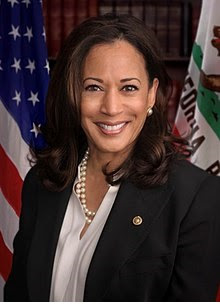
Kamala Got Heckled and Snapped Back. Does That Make Her the Antichrist?

Kamala Harris
Vice-President Kamala Harris, the Democratic nominee for the presidency of the United States, faced hecklers at a political rally in Wisconsin on October 16, 2024. Harris said that President Donald Trump had nominated three conservative justices to the Supreme Court for the purpose of overturning Roe v Wade. She remarked that they then voted to do precisely that, returning abortion legislation to the states. A lusty, pro-choice boo emerged from the crowd.

Still, no controversy goes unpunished. A small group of hecklers quickly shouted, rather indistinctly on the unedited video, “liar, liar,” “Christ is King,” and “Jesus is Lord.” (Indeed, on the raw video, “liar, liar” was the only heckle that I heard clearly. I never actually made out “Christ is King,” so I’m just taking pundits’ word that this was also one of the heckles.)

Anyway, Harris quipped back:
“Oh, you guys are at the wrong rally. I think you meant to go to the smaller one down the street.”
By “smaller one,” she was referring to Donald Trump’s rally, digging at her opponent’s obsession with crowd sizes.

The partisan press could not ignore this juicy incident. Some mainstream media outlets played the video, sometimes sneakily cutting or deemphasizing “Jesus is Lord.” In contrast, conservatives showed video clips that appeared to my ears to (1) cut the “liar, liar” heckle and (2) amplify “Jesus is Lord.” Since “liar, liar” was the first of several heckles, it was a trivial matter for conservatives to clip it out while leaving “Jesus is Lord” intact. 

They then highlighted the clipped video with headlines and captions to the effect of: 
“Christian students in Wisconsin speak out after Kamala Harris told them they were at the ‘wrong rally.’”
Interviewed later, one of the hecklers later commented that, “Jesus was mocked.” That was quite a heady accusation. 

Even more emphatic, literally linking Harris with the biblical figure of Anti-Christ, the EconoTimes headlined:
“Is Kamala Harris Anti-Christ? VP CLAPS BACK at Rally Heckler Who Shouted 'Jesus is Lord' — 'I Think You’re at the WRONG Rally!'”
The EconoTimes’ article prominently quoted “Jesus is Lord,” while ingeniously omitting the “liar, liar” heckle that immediately preceded it. 

Yet more pointedly, conservative pundit Lou Dobbs’ staff also quoted “Jesus is Lord” without mentioning “liar, liar.” Their accompanying headline, which accused Harris of being "evil," poked at her even more forcefully:
“EVIL: Kamala Harris and Her Supporters Mock Christian Attendee Shouting ‘Jesus is Lord’ During Abortion Speech — Kamala Coldly Responds, ‘You’re at the Wrong Rally’”
This is how conspiracy theories start.

First, as a simple fact, the conservative complaints arise from real evidence. Out of context, one heckler among others did, indeed, shout “Jesus is Lord.” Harris did, indeed, tell the hecklers that they were at the wrong rally. Thus, the attacks on Harris did have some fuel.

Second, however, “Jesus is Lord” quickly followed the secular heckle, “liar, liar.” Thus, “Jesus is Lord” was only one of several heckles. To be frank, judging only from the video (which seems to be all the conservative pundits judge from), I’m not convinced that I heard and understood all of the heckles. The heckles barely stood out from the background noise. How many of the rapid-fire heckles did Harris discern on the spot? Did she even hear, “Jesus is Lord?” I have no idea.

Third, the hecklers had made their political views entirely clear, and I do not think that Harris was unjustified to remark that the Trump rally would make them feel more welcome.

Fourth, the hecklers did their damage. Now, yes, the hecklers were, indeed, obnoxious, and yes, the conservative pundits did, in fact, jump to a poorly supported conclusion. The fact remains that the hecklers set Harris up, and the setup worked. “Liar, liar” was enough to trigger Harris’ response, with “Jesus is Lord” thrown in a moment later, more quietly to my ears. If “Jesus is Lord” was less audible, did Harris simply overlook it? Conservative pundits could take the entire exchange out of context and run with it. The hecklers played a dirty trick, and it worked. Frankly, if I were speaking, the trick would probably fool me, too.

As a personal aside, the Christian Right continues to befuddle me. The Holy Bible does not advise me to starve the poor, ignore the sick, and expel the immigrants. Indeed, on my plain reading, the Bible commands the opposite. Nor does the Bible say a thing about abortion. Other moral codes of ancient times did forbid or restrict abortion (e.g., the Hippocratic oath), and therefore I find the Bible’s silence on the issue to be salient. It is for those reasons that I cannot reconcile my own Christian beliefs with the Republican Party’s teachings.

Earlier Post: Mike Pence Heckled by the Christian Right Because He Didn't Bow to Trump

All the same, millions of single-issue voters choose their political candidates entirely because of their abortion policies. Proudly fervent, they ignore all other moral or political issues. They have grown so keen that abortion alone directs their judgment that a particular candidate is, or is not, a Christian. Thus, in context, “Jesus is Lord” became a partisan political statement. With that political context established, Harris’ counter-heckle seemed on point. Nevertheless, the hecklers accomplished their goal. Still, I would think that, if the entire exchange showed Harris to be anti-Christian, why did conservatives need to crop and enhance it?

Interestingly, the next Sunday, Kamala Harris attended church, and Donald Trump did not. Does that matter to the Christian Right? Evidently not.

I’ve written several times about the fine art of heckling. Sometimes heckling pays off well for the hecklers. Other times, speakers counter-heckle with great effect. More often, heckling just embarrasses everyone. Let’s call this incident a tossup.
___________

Earlier Posts:

The Lost Art of Heckling: How to Heckle and Not Sound Like an Idiot


by William D. Harpine  
___________

Research Note: Much persuasion research arises from a psychological concept called Attribution Theory. Attribution Theory examines the psychological processes listeners use to perceive and interpret other people’s behavior. For example, suppose that Pat bumps into someone. Do we attribute that to Pat’s bad manners? Or do we attribute it to Pat’s clumsiness? Or to a gust of wind that shoved Pat around? The Fundamental Attribution Error occurs when we falsely believe that someone’s behavior is intentional and motivated, when it is, in fact, not.

Psychologist Sam McLeod explains the Fundamental Attribution Error:
“People have a cognitive bias to assume that a person’s actions depend on what ‘kind’ of person that person is rather than on the social and environmental forces that influence the person.”
In this case, conservative pundits attributed Harris’ quip to her supposedly anti-Christian attitudes. Does the evidence support that attribution? Or does the attribution result from their pre-existing bias against Harris? When conservatives edited the video to cut one heckle and highlight another, were they emphasizing their point, or did they commit mere chicanery? Feel free to post your response in a comment below, or on my X.com feed


Image: Official White House photo, public domain

Copyright © 2024 by William D. Harpine

Saturday, April 20, 2024

Bill Clinton's Speech about the Columbine Massacre Asked Us to Reflect

Bill Clinton
“We know somehow that what happened to you has pierced the soul of America.”
Those were President Bill Clinton’s words in his speech to survivors of the Columbine High School massacre. A month earlier, on April 20, 1999 (25 years ago today) two Columbine High School students had killed twelve of their fellow students and a teacher. After an hours-long standoff with a tepid police response, the two shooters committed suicide.


A Speech About Values

Many subsequent post-massacre speeches and angry statements for and against gun control have filled the news. In contrast, Clinton focused on the United States of America’s moral focus. Maybe that is where we needed to focus all along. He asked his audience (his audience was not just the students and parents in front of him, but also the entire nation) to think about what is right and what is wrong, to look for ways to overcome darkness, to find ways to reconcile differences, to overcome grievances and to do the things that are right to do. Clinton talked about the future:
“… a future where what we have in common is far more important than what divides us.”
Clinton’s message speaks to us in 2024. In no other nation on earth, rich or poor, big or small, democratic, communist, or fascist, do mass school shootings occur with the horrible ferocity that has become commonplace in the United States. The satirical website The Onion comments after almost every school shooting that there is “‘No Way to Prevent This,’ Says Only Nation Where This Regularly Happens.”

Maybe, as liberal speakers have often said, the problem is too many guns. In response, conservative speakers ask whether we need more good guys with guns. Neither approach will solve the problem, though, until we recognize what is right and what is wrong.

. What is right and wrong is not just a matter of how one acts, but of what moral values a person holds dear. That was President Clinton’s message.


Joe Biden's Emotional Gun Control Plea: "Enough!"

Wayne LaPierre's Speech Opposes Gun Control with a Dark Vision


That is why, in this brief speech’s key passage, Clinton talked about overcoming the “dark forces” that make people into murderers, as well as the forces in human society that prevent us from working together:
“These dark forces that take over people and make them murder are the extreme manifestation of fear and rage with which every human being has to do combat. The older you get, the more you’ll know that a great deal of life is the struggle against every person’s own smallness and fear and anger and a continuing effort not to blame other people for our own shortcomings or our fears.”
All human beings, as Clinton reminded us, struggle with dark forces. Can we overcome the “smallness” of our thinking? Can we not recognize that fear leads to anger, but we can control our fear and anger?

Yes, Clinton briefly mentioned that the nation needs to keep firearms out of dangerous peoples’ hands. That, however, was not his main point. His main point was for us to examine our morals.
Clinton’s larger, moral context persuaded few people at the time, and would probably persuade fewer today. We cannot move forward with reasonable gun control until we understand our fear and anger. We cannot resolve school violence until we view education as something greater than getting good scores on computer-graded multiple-choice tests. A few generations ago, schools knew that part of their job was moral education: to teach tolerance, to make people aware of their history and culture, and to instill such all-American values as freedom of expression and religion. My intermediate school principal called our school campus “a plant,” as if the school were an industrial operation, rather than a cultural institution. I have not heard that bizarre term recently, but our nation has still not figured out what functions it wants schools to serve.


Anywhere Could Become Columbine

Clinton’s Columbine speech was not, however, just about one school in Colorado. Clinton reminded his audience that:
“We know if this can happen here, it can happen anywhere.”
Indeed, Clinton remarked about the “fundamentally strong values and character” of the people of Jefferson County, Colorado. He was right about that! Yet, for that solid community, “Columbine” is forever engraved on American memory as a symbol of violence, social disorganization, and moral failure. Indeed, school massacres have become a nationwide affliction, as fear and anger continue to tear apart many of the United States’ seemingly most stable neighborhoods. When they happen, we say that they are “another Columbine.”

Any number of policies might help. Should we control gun ownership by people who are known to be dangerous? We might ask, how do teenagers build bombs in their parents’ garage, and no one notices? What about school bullying? Can we recognize mental health issues before they lead to disaster? Do we need better trained, more organized police? Progress on all those fronts continues to be slow, if not nil, twenty-five long years later.

Emma González at the "March for Our Lives" Rally


Clinton’s Larger Purpose

Public speaking’s highest purpose is to awaken our moral sensibilities.

So, Clinton pointed out that before we can solve the detailed issues of policy, we must settle a more fundamental point. Clinton’s Columbine speech cried out for us to reflect. Clinton was right that the United States needs to determine what it stands for. Unfortunately, we seem to have wandered even farther from that determination than we were 25 years ago. Do we stand for each other, or do we want to destroy one another? Heaven help us.

by William D. Harpine

______________

Research note: Ceremonial speeches (the old term is epideictic speech) often talk about values, while subtly encouraging the audience to think of actions that fulfill their values. I have written about epideictic rhetoric a number of times; here is a free preprint of one of my papers on the topic. For more, click on “William D. Harpine’s Publications” at the link above. 

Copyright © 2024, William D. Harpine

Image: National Archives, public domain, via Wikimedia Commons

Tuesday, February 20, 2024

Dr. Margaret Chan Organized Her Public Health Speech for Success

“Public health constantly struggles to hold infectious diseases at bay, to change lifestyle behaviors, and to find enough money to do these and many other jobs.”
As Dr. Margaret Chan, Director-General of the World Health Organization spoke at the 69th World Health Assembly in Geneva, Switzerland, on May 23, 2016, she demonstrated how important organization is in public speaking. Dr. Chan, a physician of joint Chinese and Canadian nationality, illustrated just how crucial the organizational structure of a speech is to informing and persuading people.

Her speech is still timely today, as public health authorities at this very moment struggle to make the public accept basic public health measures such as vaccination and social distancing to cope with endemic and deadly COVID-19 and RSV viruses that devastate the population. Indeed, many nations, including the United States, continue to suffer from needless public health disasters.


Chan Used Organization to Persuade the Audience

Her speech’s organizational structure brilliantly offered the audience positive thoughts about public health, which, in turn, gave a positive approach to the great public health challenges that lay ahead. She started with public health’s recent accomplishments, warned of current public health threats, and finally returned to a hopeful approach to public health. Her speech structure helped show that, since public health has triumphed in the past, we can believe that it can help us in the future.


Chan Stated the Problem

Starting her speech, Dr. Chan briefly noted that public health faces an endless battle for resources and public acceptance. In her speech, she made a two-fold point: public health measures have greatly improved human lives across the world, and yet the changing world landscape poses increasingly dire public health threats.


Chan Reviewed Public Health’s Triumphs

Dr. Chan immediately moved to public health triumphs: “Sometimes,” she said, “we need to step back—we need to step back and celebrate.”

Yes, she was right. Since public health has faced constant public and political pushback—for centuries—it is important to look at what has been accomplished. Wisely, Dr. Chan talked only about the most recent public health accomplishments. She began with the Millennium Development Goals, a United Nations program to wipe out extreme poverty, reduce the deaths of young children, improve childbirth safety, and fight endemic contagious diseases, while improving the environment. These were truly ambitious goals. Dr. Chan said:
“Commitment to the Millennium Development Goals brought focus, energy, creative innovation, and above all money to bear on some of the biggest health challenges that marred the start of this century.”
Delivery of Malaria Treatment
Dr. Chan quickly focused on the resulting dramatic reductions in needless deaths:
“We can celebrate the 19,000 fewer children dying every day, the 44% drop in maternal mortality, and the 85% of tuberculosis cases that are successfully cured.

“Africa in particular can celebrate the 60% decline in malaria mortality, especially since the African Leaders Malaria Alliance, supported by partners, did so much to make this happen.”
These are stunning accomplishments from the multinational public health measures. Indeed, seeking to gain increased support for public health, Dr. Chan forcefully reminded the audience that cooperative efforts have brought so much that is good.

WHO's Tedros Adhanom Ghebreyesus Spoke for Public Health in a Positive Way During His Coronavirus Briefing


The Need for International Efforts

In the modern world, Dr. Chan insisted, public health threats rarely remain in any single region. Worldwide effort is therefore the only solution. She pointed out that air pollution drifts across the world, while superbugs travel with international commerce, and unhealthy foods are marketed internationally. The effects can be striking:
“Few health threats are local anymore. And few health threats can be managed by the health sector acting alone.”
Dr. Chan then focused on the hardest issue of all, the human-caused disasters that spread poor health across the world:
“As the international community enters the era of sustainable development, the global health landscape is being shaped by 3 slow-motion disasters: a changing climate, the failure of more and more mainstay antimicrobials, and the rise of chronic noncommunicable diseases as the leading killers worldwide.”
Refusing to call these disasters the natural consequence of human growth or biological evolution, Dr. Chan instead reminded the audience that these public health concerns were the consequences of short-term economic policies:
“These are not natural disasters. They are man-made disasters created by policies that place economic interests above concerns about the well-being of human lives and the planet that sustains them.”
For example, she noted that food companies make more money from processed foods than from fresh produce, and that fossil fuels generate great wealth in producing nations. Yet, as she had shown, these economic factors contribute to ongoing public health failures.


Yet, Let Us Move Forward

Still, consistent with her positive theme, Dr. Chan concluded her speech, not by wallowing in the horrors of modern public health failures, but by, once again, pointing to the ways in which advanced public health can continue to save millions upon millions of human lives:
“WHO, together with its multiple partners, is poised to save many more millions of lives. I ask you to remember this purpose as we go through an agenda that can mean so much for the future.”

The Organization Theme

This speech represented a psychological approach to rhetorical organization. The speaker began by praising public health's massive recent accomplishments. It was her deliberate rhetorical choice to emphasize, not historical triumphs like the polio vaccine, but the most recent triumphs in overcoming disease. The bulk of her speech revealed the public health problems that the world faces today—problems exacerbated by poor international policy decisions. She did not shy away from problems that her own nation, China itself, had produced, like excessive burning of fossil fuels. She ended on a positive note, urging the audience to move forward.

Public health depends on public attitudes. Today, my own nation, the United States of America, has been ravaged by the novel coronavirus, while much of its population succumbs to bizarre conspiracy theories, refusing to accept vaccination and other basic public health measures. The United States ranks near the bottom of the industrialized world for maternal and child mortality, and, worse, we seem to be declining. Shockingly, The Commonwealth Fund notes that, “The U.S. has the highest maternal mortality rate among developed countries.” The biggest problem in public health is communication and persuasion—not science (the scientists are doing their jobs).


Dr. Chan’s message was just one speech to one audience, but she modeled how to overcome our thought barriers and improve public health.

In a more general way, public speakers often underestimate how important it is to organize a speech psychologically. In this case, Dr. Chan led her audience through a psychological process: past triumphs, present despair, and (ending with a call to action), future triumphs. She showed her audience that there was a way to overcome the massive public health threats that the world faces. Did the world listen in 2016? Are we listening today?

By William D. Harpine

_______________

P.S. ­ Dr. Margaret Chan has been involved in occasional political controversies. That might be inevitable for someone of her prestige and influence, yet the public often focuses on political issues while ignoring the massively important lessons that she was trying to teach.

Also, while Dr. Chan gave such a thoughtful speech, American public health officials have, in recent years, done a mostly terrible job of communicating with the public. I’ll see if I can write about that in a future post.

Thanks to the good people at AmericanRhetoric.com, a website founded by my late classmate Dr. Martin J. Medhurst, for finding and posting this important speech.

Copyright 2024, William D. Harpine

Image: United States Department of Health and Human Services, public domain, via Wikimedia Commons

Tuesday, January 16, 2024

Kamala Harris Gave a Simple Message about Keeping Children Safe from Guns. Is It Enough?

Kamala Harris
Warning of the horrors of gun violence that America's children face daily, Vice President Kamala Harris said, “let’s understand how many people in our country, including the children, are experiencing profound trauma.

A simple message bears repeating. Needs repeating. 

Harris visited Eastway Middle School in Charlotte, North Carolina on January 11th, 2024, to host a Roundtable Discussion on Gun Violence Prevention in Charlotte, North Carolina.

After meeting privately with a group of students, Harris delivered a brief, thoughtful speech in which she thanked community leaders for trying to protect our children from being shot. She gave the kind of straightforward message that jaded audiences tend to ignore. Can Harris give her simple message more force?  Yes, of course she can, but there is a “but.” The “but” is that they need to repeat their messages, over and over, because, as the saying goes, quantity has a quality all its own. Harris’ speech, by itself, gained little attention, but a speaking tour might. So, after discussing Harris’ comments, I’ll go back in history to show how a politician can gain attention by calmly repeating a message.


A Simple, Profound Message

Now, during her brief speech, Harris gave her key point in one simple, stark, quotable statement:
“…in the United States of America today the number one killer of our children in America is gun violence — not car accidents, not some form of cancer. Gun violence is the number one killer of the children of America.”
That simple fact should, in principle, fill parents with fear. Yes, parents might worry instead about what books their children read, what clothes they wear in school, and who they make friends with. Some parents are terrified that children might see a drag show or learn about Jim Crow laws. We have become so numb to school shootings and random drive-bys that we easily forget that the main danger that children face in the United States is that someone will shoot them. Harris focused squarely on that simple fact.

Harris used the power of her office to remind all of us of one basic, fundamental danger. She calmly made a positive point about community involvement and children’s safety. She stated the simple fact that gun violence is the greatest threat to children. Will that be enough?

Harris’ speech received some attention in the press, although not as much as the issue deserves. While the nation grows breathless over migrant crossings at Eagle Pass, drag shows, or Donald Trump’s latest rant, why do we pay so little attention to the gun violence that poses, by far, the greatest threat to our nation’s youth? “Ho, hum,” Americans say, “a dozen children were shot dead yesterday. Ho, hum.” For, although the issue remains important, Harris does not try to draw all of the air out of the room by spreading hysterical conspiracy theories. Will her message have a long-term effect? If she and other advocates pound away on this issue often enough, will the public begin to take it more seriously? 


How McKinley Did It


Yet, simple messages can succeed if the speaker is persistent. History teaches this lesson. In 1899, with the Spanish-American War safely in the history books, President William McKinley faced the daunting task of convincing the United States to become a world imperial power by annexing the Philippine islands. Many Americans, especially in the conservative South favored letting the Filipinos have their own government. McKinley went on a series of speaking tours through the nation, particularly in the hostile South (McKinley was a Union Civil War hero!), to sell his ideas. He avoided startling language. His policy discussions were vague and safe. His speeches were calm and dignified. He gave his respects to dead Confederate soldiers. He often traveled with General Joseph Wheeler, a southerner who was a hero of both the Civil War and the Spanish American War. Even Southerners who didn't like McKinley cheered for Wheeler. McKinley's tours gained public support and the Senate ratified the treaty.

I'll write some more about McKinley in the future. In the meantime, here are the lessons:

1. A speaker can gain attention without screaming like a lunatic.

2. A speaker who wants to sell a contentious idea can't just talk to supporters. A speaker also needs to reach out to unfriendly audiences. That takes determination.

3. Traveling not only gives the speaker new audiences, but also access to the local press. More local papers (today, more local TV coverage)—more attention!

4. It is rare for one speech, no matter how good, to do the job. Persistence means success.


Back to Harris

So, it is fine for Harris to give calm, safe, speeches. Democrats don’t need to act like Republicans. Harris just needs to give more calm, reasoned speeches, and to give them in more places to more audiences. Sadly, few Americans even know that she went there. However, people would eventually notice if she toured many middle schools to talk about gun violence.

Overall, Joe Biden and Kamala Harris are giving good speeches to good audiences, and they are making good points. They just aren't doing it enough. Speakers do not need to draw all the oxygen out of the room. They don't need to scream conspiracy theories. They just need to make sense, over, and over, and over again. As much as anything, speakers need to be persistent. 

After all, when Harris said that, “the number one killer of our children in America is gun violence,” that powerful statement should terrify any parent. But to say it only once, or only a few times? Never enough. Why isn’t she giving three or four speeches a week about gun violence, across the country, including at least some speeches at events and schools in the gun culture regions? A speaker needs to be heard.
______________


Earlier Post: Kamala Harris' Speech at West Point: Tradition and Innovation

Earlier Post: Kamala Harris' College Speech: Voting is the Way
______________


Conclusion

Still, Harris focused—and focused precisely—on the danger that firearms pose to children. That represents a step toward raising public interest in the threat. Will the nation listen? Or not?

By William D. Harpine

______________

Research note: I discussed McKinley’s speaking tours in a chapter of Before the Rhetorical Presidency, edited by the late Martin J. Medhurst. Available new or used from Amazon, and can be read in large research libraries. (Disclosure: I do not get royalties from this one, but I was proud to write the chapter.) 

Also, here is a full text of a convention paper that I presented about McKinley’s speaking tours. 

Click “William D. Harpine’s Publications” at the link above for more of my writing about McKinley. 


Copyright © 2024, William D. Harpine
Image: Official White House photo

Saturday, December 30, 2023

Tweeters Need Research: The Sad Case of Governor Abbott and the Christian Right

Just as speakers need to check their facts, so do politicians on social media. After the Houston Chronicle published an impassioned editorial to remind readers that Jesus, Mary, and Joseph were political refugees, Governor Greg Abbott of Texas posted this obnoxious post on X (formerly Twitter):
“Chron doesn’t know the story of Mary & Joseph. They weren’t 'refugees' (look up definition)

Read Luke 2:1-10 They were ordered by the govt to go to Bethlehem to register for the census.

Nice distortion. Doing Devil’s work.”


Wow! “Devil’s work!” Strong words from a mass-going Catholic and scion of the Christian Right, who, evidently, needed to recheck the Bible. Reinforcing his ridicule, Abbott added 3 emoji of faces laughing themselves to tears. 


Did Abbott Read All of the Gospels? 

But Abbott did not do his research. For the Holy Family’s refugee story is found, not in the Gospel of Luke, as Abbott imagined, but in the Gospel of Matthew. That is, traveling among Nazareth, Jerusalem, and Bethlehem, as described in Luke, did not make Jesus and his family refugees. According to Matthew’s gospel, however, they escaped their country and fled to Egypt to escape political persecution from King Herod. That is what made them refugees, but that story is not found in the Gospel of Luke! There are two stories of the birth of Jesus Christ in the Gospel, and Christians know to read both.

Earlier Post: Mike Lee Tries to Make Fun of the Green New Deal but Only Makes Fun of Himself (P.S.: Speakers Need Research)

So, in the second chapter of Matthew (so you don’t need to read very far), we read the story of the Wise Men (or Magi). The Magi came from the east, following a star. (Surely Abbott has heard about the Star of Bethlehem? But, then, maybe not). The Magi told King Herod that:
“And thou Bethlehem, in the land of Juda, art not the least among the princes of Juda: for out of thee shall come a Governor, that shall rule my people Israel.” (Matthew 2:6 KJV)
This disturbed Herod, who figured that he, not some upstart from Bethlehem, was governor of Judea. So, forging a crafty plan, Herod told the Magi:
“And he sent them to Bethlehem, and said, Go and search diligently for the young child; and when ye have found him, bring me word again, that I may come and worship him also.” (Matthew 2:8 KJV)
The Magi found Jesus and gave him gifts of “gold, and frankincense, and myrrh” (Matthew 2:11 KJV).  However, being warned in a dream, the Magi did not return to Herod and took another road home. Enraged, malicious, and fearful (like most dictators), Herod ordered that all boys under the age of two should be put to the sword (Matthew 2:16). This would, he figured, ensure that the future upstart governor would meet his end. 


Escaping to Egypt to Avoid Political Execution

The Holy Family foiled Herod’s plot, however, for Jesus, Mary, and Joseph became political refugees. Having been warned in a dream, Joseph collected his family and fled to Egypt to avoid Herod’s slaughter. They remained there, safe from political persecution, until the king died:
“And when they were departed, behold, the angel of the Lord appeareth to Joseph in a dream, saying, Arise, and take the young child and his mother, and flee into Egypt, and be thou there until I bring thee word: for Herod will seek the young child to destroy him.
“When he arose, he took the young child and his mother by night, and departed into Egypt: was there until the death of Herod: that it might be fulfilled which was spoken of the Lord by the prophet, saying, Out of Egypt have I called my son.” (Matthew 2:13-14 KJV).
After Herod’s death, Joseph received another dream (many dreams in this story) that Herod had died. Joseph took his family to Nazareth, and the gospel narrative continued.

Earlier Post: Romans 13, Jeff Sessions, and the Cultural Heritage of Conservative Immigration Policy


Research Is Important

So, let the reader recognize Governor Abbott's astonishing arrogance. Not only did he fail to make even the most minimal effort to look at the biblical accounts of Jesus’ birth, but he snarked at the Houston Chronicle’s writers, who obviously had read the Bible. Abbot said: 
“Nice distortion. Doing Devil’s work.”
Just as speakers need research, so do politicians who post on social media.

Nativity Scene, Shepherds on Left, Magi on the Right

It is, on the one hand, bizarre that Governor Abbott, who loves to appeal to conservative Christian voters, did not know the familiar story. After all, almost every Christmas creche scene features the Magi (Gospel of Matthew) visiting the baby Jesus, lying in a manger (Gospel of Luke), right next to the shepherds (Gospel of Luke) who also paid a call. Still, on the other hand, Abbot’s mistake reminds us of the object lesson: that we should check our facts before we speak.

The sad part is that Abbott’s obviously cruel, inaccurate account of the Bible story might gain him votes from the Christian Right. 


______________________

P.S. The underlying complexity, of course, arises because a narrative of Jesus’ birth only appears in two places in the Bible. In Matthew, we encounter the Star of Bethlehem, the Magi (or Wise Men), the flight to Egypt, and the slaughter of the innocents. In Luke, we read the Magnificat. We then find (still in Luke) that Jesus was laid in a manger and was visited by shepherds, following which the family traveled peacefully to Jerusalem and Nazareth. Abbott is aware, obviously, that the Gospel of Luke does not feature any political refugees. If only Abbott had also read Matthew, the very first book of the New Testament! 

The Magi, of course, were priests of the Zoroastrian faith.

As the reader can see, the different accounts of Jesus’ birth are, well, different, and I will let theologians argue about whether they are, or are not consistent, as well as whether they do, or do not, possess any verifiable historical accuracy. Anyway, today (December 30) is the traditional fifth day of Christmas (the count starts on December 26 for some traditional reason), so, maybe, if you are lucky, your true love will give you five golden rings today. One can always hope!

The Chronicle gave a polite, well-argued response to Abbott’s attack.
 

My wife, Dr. Elaine Clanton Harpine, bought the pictured lovely, hand-carved nativity scene while she was still in school.

by William D. Harpine

Copyright © 2023 William D. Harpine

Nativity Scene Image: William D. Harpine, © 2023