Showing posts with label Tariffs. Show all posts

Sunday, March 30, 2025

“Liberation Day in America”: Trump's Tariff Speech


“So, this is the beginning of Liberation Day in America.” 
So said President Donald Trump when he announced a 25% tariff on imported automobiles in an Oval Office address on March 27, 2025. “Liberation” is what rhetorical theorist Richard Weaver calls a “god term.” To Weaver, a “god term” is not a religious concept, but rather a metaphor that conveys cultural values that are too intense to question. The word “liberation” carries such power, and is so deeply seated in the United States’ cultural ideology, that few people would doubt it. Other “god terms” from various historical eras might include “progress,” “justice,” or “freedom.”

Viewed as nuts-and-bolts economics, Trump’s policies are dubious at best. Nevertheless, his conversation-stopping sales slogan – “Liberation Day in America” – turned his policy into a matter of pride, hope, and freedom. “Liberation Day” doesn’t make us think about economic charts or government statistics. Instead, it makes us think about ending slavery, emptying concentration camps, and gaining independence. “Liberation Day in America” elevates the discourse to patriotism’s greatest heights. That is the value-laden power of god terms.

That is, Trump pushed ideals, not theory. Trump’s pro-tariff argument assumes, quite falsely, that tariffs place a charge on exporters who exploit the United States. He explained this false premise by saying:
“We’re going to charge countries for doing business in our country and taking our jobs, taking our wealth, taking a lot of things that they've been taking over the years. They've taken so much out of our country, friend and foe. And frankly, friend has been oftentimes much worse than foe.”
He offered no proof that other countries have harmed us. Just because he says someone has harmed us does not make it so. Instead, “charge countries” falsely but persuasively switches the economic burden to the nations that Trump thinks are harming us. 

Trump’s argument overlooks a simple point, which is that importers, not exporters, pay tariffs - any tariffs! Importers pay tariffs as products arrive in American ports and then pass the cost to their customers. Tariffs are collected when imports are received, not when they are sent. This lays the expense directly on the United States, not the exporters. As the Stanford Institute for Economic Policy Research points out, “Studies show that tariffs imposed during the first Trump administration were almost entirely borne by U.S. consumers.” [italics added]

In Trump’s speech, however, liberation is the point. Studies are not the point. Having said that imports threatened the United States, Trump concluded that we must liberate ourselves from foreign competition. Trump promised that competitors would build factories in the United States and thus stimulate the United States’ economy. As history shows, that isn’t how it works.

Trump's Tariffs versus Henry Clay's "American System"

By using a god term, however, Trump shoved detailed economic questions aside. We’re talking about “Liberation Day in America.” We are not talking about statistics. No, we are talking about values: freedom and independence. Liberation. Liberty. The Statue of Liberty. A 25-cent coin carries the word “Liberty.” In Trump’s speech, we are liberating ourselves from foreign competition. “Liberation Day” creates a powerful image that makes America sound great. It is the kind of phrase that can inspire listeners to pride.

For, after all, Trump’s motto is “Make America Great Again.” Greatness is a value, and god terms like “Liberation” are about values. “Liberation Day” does not inform people about economic charts or statistics. How boring that would be! “Liberation” is a god term. We do not want other nations to exploit us, and Trump promised a great day of liberation. “Liberation Day” does not inform us, for Trump’s purpose was not to inform, but to make us feel free. 

McKinley's 1896 Speeches Made the Tariff Sound Patriotic - Just Like Trump!

Franklin Roosevelt's Speech against Tariffs

That image, the idea that Trump will free the United States of America, offers relief and salvation. Our culture values liberty above all else. That’s why the word “Liberty” adorns our coins, our statues, and our textbooks. A supposed hero who will, he promises, liberate us from our friends and enemies alike used a god term to remind us of our values and lead us to economic redemption. Are Trump’s tariff policies stunningly unwise? Sadly, yes, but that is not really his point. Is his rhetoric spectacularly compelling? Obviously yes. Underestimate value-driven speeches at your peril. “Liberation Day” might sound grandiose; it might defy logic, but its essence is powerful indeed.  

by William D. Harpine

________________

Research Note: Conservative rhetorical theorist Richard Weaver talks about god terms in his insightful book, The Ethics of Rhetoric. Kenneth Burke’s ground-breaking book A Grammar of Motives offers a somewhat different explanation of “god-terms.”  

Copyright 2025 by William D. Harpine

Image from White House YouTube Channel

Saturday, March 15, 2025

Franklin Roosevelt's Speech Against Tariffs

Franklin Delano Roosevelt
The protective tariff has dominated economic rhetoric almost since our nation’s dawning. From Henry Clay to William McKinley to Donald Trump, politicians promise (dubiously) that tariffs will be an “American System” or put “America First.” Those are powerful words. Tariffs are always popular, but they are usually a terrible idea.

Although tariffs might help the few, they will, overall, cause more harm than good. Writing for the conservative Cato Institute, Erica York remarks that: “It is dubious to claim that tariffs can be imposed with no economic trade-offs, and economists generally consider them to be poor tools for achieving various policy objectives.”


Franklin Roosevelt explained this important principle, almost alone among the United States' leaders. Speaking during the depths of the Great Depression at the Commonwealth Club in San Francisco on September 23, 1932, during his first presidential campaign, Roosevelt linked tariffs to the ancient battle between the rich and powerful versus the ordinary citizen:

“The issue of government has always been whether individual men and women will have to serve some system of government of economics, or whether a system of government and economics exists to serve individual men and women.”

Thus, Roosevelt did not discuss the economy by throwing out complex facts and figures and percentages, or by citing mathematical formulas. Instead, he put the tariff controversy in its human context. He showed how the protective tariff was a government regulation that harmed the overall economy, disrupted international relations, and degraded the nation’s welfare.

As Roosevelt spoke, the massive Smoot-Hawley Tariff had been crushing the world economy and, according to almost all economists, worsening the Great Depression. Economics Professor Kris James Mitchener comments that the Smoot-Hawley Act triggered “the mother of all trade wars.”

Thus, Roosevelt showed considerable insight when he noted how the anti-regulation businessperson:

“…is the first to go to Washington and ask the government for a prohibitory tariff on his product.”

As he spoke, building on that contradiction, Roosevelt developed the theme that the rich and powerful seek their own benefit at the nation’s expense. 


Roosevelt Opposed the Tariffs

Roosevelt placed the tariff into its historical background from the 1800s:

"The tariff was originally imposed for the purpose of 'fostering our infant industry', a phrase I think the older among you will remember as a political issue not so long ago."

 
Yet, after reviewing the history of the American economy (quite an enterprise for a short speech!), Roosevelt squarely ridiculed the contradiction of modern businesspeople who want to keep the government away from business and yet demand that the government protect them with tariffs. In contrast, Roosevelt insisted, as almost all economists do, that tariffs defend particular industries at a cost to the overall economy. Tariffs cause trade wars, he explained, and the trade wars restrict the markets to which American industries can sell their products. Oddly, instead of encouraging American business, tariffs force businesses to locate their factories overseas. While a few benefit, the many suffer a downturn. Roosevelt explained as he continued:

“Our system of constantly rising tariffs has at last reacted against us to the point of closing our Canadian frontier on the north, our European markets on the east, many of our Latin American markets to the south, and a goodly proportion of our Pacific markets on the west, through the retaliatory tariffs of those countries. It has forced many of our great industrial institutions who exported their surplus production to such countries, to establish plants in such countries within the tariff walls.”

(Doesn’t that sound just like Donald Trump’s trade war? But I digress.)


A Message of Hope

Yet, like all great leaders, Roosevelt ended his speech, not with fear, but with a message of hope. As a terrible economic depression wracked the world, Roosevelt urged the American people to fulfill their old values – which he called “the old social contract” – to avoid “a rising tide of misery engendered by a common failure” – and to work together as a common people, for economic recovery:

“… failure is not an American habit; and in the strength of great hope, we must all shoulder our common load.”

Of course, the economic troubles that the United States of America faces today, although real, have not reached the massive disaster of the Great Depression--yet. Still, we must ask whether we as a nation have failed to learn from history’s most terrible mistakes. Can we find leaders today who can explain why and how narrow economic policies harm the overall public? Can we find leaders who can help people understand difficult economic forces? Sadly, those questions remain open.

Unfortunately, politicians instead continue to promote harmful economic policies in the face of overwhelming resistance from economic theory and history. 


Tariffs Harm the Economy

So, yes, economic historians have long concluded that protective tariffs worsened the Great Depression. Indeed, studying the Great Depression, economists Mario J. Crucini and James Kahn suggest in the Journal of Monetary Economics that “the global escalation of the tariff war precipitated the collapse of world trade, along with declines of several percent in international output and investment.”
Reed Smoot

Similarly, Douglas A. Irwin writes in the Annual Review of Economics that, “Perhaps the most important ramification of the Smoot–Hawley Tariff was its role in triggering retaliation against US exports.” By economic principles, Roosevelt's controversial speech was squarely in the right. 

Yet, the public loves tariffs despite the historical evidence that tariffs and tariff wars harm the economy. So, is it any surprise that President Donald Trump embarked on a massive tariff war, not during a depression, but during a time of relative prosperity? His Press Secretary described this as an “America First Trade Policy” and an “America First economic agenda.” Did she not merely echo Henry Clay's speech on the pro-tariff American system? Or William McKinley's argument that tariffs and the American flag were patriotism's soul? 


Conclusion

The protective tariff is one of the United States’ oldest economic controversies, and thus one of the oldest subjects that political speakers discuss. Indeed, if we want to understand today’s political controversy, the old speeches, like Roosevelt's masterful speech to the Commonwealth Club, can be a great learning tool. Avoiding excessively technical discussions, Roosevelt used history’s lessons to help American voters understand how the protective tariff was hurting them while helping only the very few. People do not always understand technical arguments. Statistical charts make our eyes glaze over. People can, however, understand basic values. People can understand the eternal battle between the great and the small, between the haves and the have-nots, and between an overall view versus a narrow view. His grasp of human context helped Roosevelt gain a massive victory in the 1932 election. 

by William D. Harpine

____________________

Research Note: AmericanRhetoric.com is a terrific website, established by my graduate school classmate Martin J. Medhurst, that contains texts (and often videos) of American speeches. 


Copyright © 2025 by William D. Harpine

Images of Roosevelt and Smoot, public domain, via Wikimedia Commons


Thursday, August 13, 2020

Donald Trump's Speech to the Whirlpool Workers Promoted His America First Policies

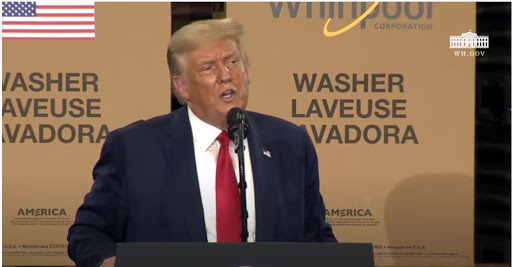
Donald Trump at Whirlpool factory, WH YouTube channel
President Donald Trump’s recent speech at the Whirlpool Corporation in Clyde, Ohio, almost unnoticed by the press, helped him score major political points. Trump continues to hold on to a solid 30% to 40% approval or popularity rating among American voters. This is despite a raging pandemic, the lack of an effective public health policy, economic collapse, and a dysfunctional government. 

One reason is that Trump quietly continues his America First philosophy: high tariffs and a trade war. Yes, racism and ethnic backlash also boost his popularity among his base voters. Let us never forget, however, that people vote their pocketbooks. As it happens, many Americans fear that foreign competition sucks money out of their pocketbooks.

Yet tariffs are a bad idea. Economists have trouble agreeing on anything more controversial than the morning sunrise – except for tariffs. As conservative economist Greg Mankiw explains, “There are few things economists are unanimous about, but support of free trade comes pretty close.” All the same, tariffs get votes.

Earlier Post: Trump at "Protecting American Workers Roundtable"

Trump’s unilaterally-imposed tariffs especially targeted China. Trade Partnership Worldwide estimates that Trump’s tariffs had cost United States industry about $46 billion by the end of 2019. 

At the same time, while basic economic theory universally opposes tariffs, tariffs do help to protect inefficient domestic industries. Those industries’ workers and investors are grateful to be protected. Furthermore, jobs gained because of tariffs, although relatively few, are obvious and unmistakable. However, when tariffs cause the economy to slow down overall, costing a great many more jobs than the ones that are saved, the effect spreads out over the entire nation. This leaves the harms so watered-down that we easily overlook them. Trump’s tariffs fill protected workers with joy, while the people whom tariffs hurt probably don’t understand that the tariffs hurt them. 

So, let’s look at Trump’s speech to Whirlpool workers. Like most good public speakers, Trump stated his thesis right off, and his thesis was that he, personally, had stimulated Whirlpool’s business:

“I’ve been very good to you.  We’ve been good to each other.  With the incredible men and women of Whirlpool, the largest washing machine factory anywhere in the world.

“Every day, 20,000 gleaming new machines coming rolling off that beautiful assembly line — I just got to see it — and every single one is proudly inscribed with that glorious phrase, ‘Made in the USA.’  Remember?  (Applause.)  Made in the USA.”

“Made in the USA.” Repetition can exert a powerful effect. Trump isn't always sharp on the facts, but he uses repetition to powerful effect.  

That was an interesting trick at the beginning, wasn’t it? Trump had imposed the tariffs unilaterally. By dubiously using the “Trading with the Enemy Act of 1917” to bypass Congress, which he knew would never approve his tariffs, Trump stretched executive power beyond its reasonable limit. Doing so, he ensured that he, and he alone, could claim credit. That's why he could say, “I’ve been very good to you.”  Everybody knew that no one else had helped them impose the tariffs. Trump also made the tariffs transactional: he had helped the workers, and “we've been good to each other.” He gives them tariffs; they give him votes. 

Continuing, Trump quickly tied his accomplishments back to his America First philosophy: 

“The duty of a President is to put this nation’s own citizens first.  That’s why my administration swears by two simple but crucial rules: Buy American and Hire American.  (Applause.)” 

Trump echoed William McKinley's old call for “reciprocity.” He explained: 

“I committed to impose tariffs on goods to protect American jobs and stop China and many other countries’ abuses.”


Earlier Post: William McKinley Made the Tariff Sound Patriotic: Just Like Trump!


Therein, of course, lies the tariff's appeal. Foreign trade is good economics, but it doesn't sound patriotic
. In contrast, the protective tariff quickly morphs into patriotism. This worked for William McKinley, who twice won the presidency on a protective tariff platform. Before him, Henry Clay made a career of supporting the protective tariff. Herbert Hoover foolishly thought that a protective tariff would end the Great Depression; of course, tariffs inevitably sucked even more jobs from the economy.


Earlier Post: Trump Sounds Like Henry Clay, Tariffs Win Votes


Continuing, Trump emphasized that he had imposed tariffs to help American workers:

“But this time, there was one big difference: Instead of an administration that sold out American workers and sold your company out and couldn’t have cared less for you, you finally had a president who stood up for the American worker.”

 And he continued to brag about jobs that his tariffs had created:

“That includes thousands of new jobs across the Ohio supply chain, from right here in Clyde to Findlay, Ottawa, Greenville, and Marion.  (Applause.)  All over.”

The crowd applauded and cheered throughout Trump’s speech. He scored points with them, no doubt about it.  

As it happens, I shopped for a new dishwasher this week. Whirlpool was my first choice. I soon discovered that the trade war has driven all dishwasher brands into short supply (our local appliance store has trouble getting them into stock), while ordinary repair parts are on two-week backorder. Appliance prices have skyrocketed. Yes, I prefer American-made appliances. Yes, I’m glad that Whirlpool workers have their jobs.  Nevertheless, the trade war that helped them continues to hurt American consumers, just as economists predicted. A 2019 economic study discovered that tariffs caused washing machine prices to go up by about 12%, and that each of the 1,800 jobs created cost American consumers US $815,000. Put it that way, and tariffs no longer sound like a big bargain.

The tariff can still be popular because the 12% increase in the price of washing machines costs the typical American consumer less than $100, and that’s only if the consumer buys a washing machine this year. However, spread those tariffs over many industries and many consumers, and tariffs turn into a bad deal indeed.

Always popular, tariffs have gained votes throughout American history. All the same, they have never been a good idea. While the press continues to obsess about Trump’s angry racism and power grabs, he works steadily, almost under the radar, to protect favored American industries. As he does so, industry workers respond by supporting him.

So, Trump told the Whirlpool workers that he had brought their jobs back by imposing tariffs, for which he took sole credit, while reminding them that he opposed unfair trade practices that hurt them. He cited numbers to support his point. Trump used his speech to equate tariffs with patriotism. He assured the workers that he was on their side. He spoke directly to the exact workers whose jobs he had created, while boxes full of washing machines, emblazoned with American flags, sat behind him. It is, however, less persuasive – less personal – for economists to note abstractly that tariffs drive down the aggregate number of jobs.

Is America First bad policy? Yes. Is it politically and rhetorically persuasive? Absolutely.


Image: Donald Trump speaks at Whirlpool factory, White House YouTube channel